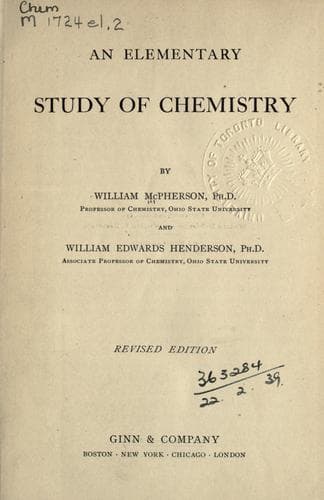
An Elementary Study of ChemistryMcPherson, William
Science
An Elementary Study of Chemistry
McPherson, William
Chemistry
~Silicon dioxide~ (_silica_) (SiO_{2}). This substance is found in a great
variety of forms in nature, both in the amorphous and in the crystalline
condition. In the form of quartz it is found in beautifully formed
six-sided prisms, sometimes of great size. When pure it is perfectly
transparent and colorless. Some colored varieties are given special
names, as amethyst (violet), rose quartz (pale pink), smoky or milky
quartz (colored and opaque). Other varieties of silicon dioxide, some of
which also contain water, are chalcedony, onyx, jasper, opal, agate, and
flint. Sand and sandstone are largely silicon dioxide.
~Properties.~ As obtained by chemical processes silicon dioxide is an
amorphous white powder. In the crystallized state it is very hard and
has a density of 2.6. It is insoluble in water and in most chemical
reagents, and requires the hottest oxyhydrogen flame for fusion. Acids,
excepting hydrofluoric acid, have little action on it, and it requires
the most energetic reducing agents to deprive it of oxygen. It is the
anhydride of an acid, and consequently it dissolves in fused alkalis to
form silicates. Being nonvolatile, it will drive out most other
anhydrides when heated to a high temperature with their salts,
especially when the silicates so formed are fusible. The following
equations illustrate this property:
Na_{2}CO_{3} + SiO_{2} = Na_{2}SiO_{3} + CO_{2},
Na_{2}SO_{4} + SiO_{2} = Na_{2}SiO_{3} + SO_{3}.
~Silicic acids.~ Silicon forms two simple acids, orthosilicic acid
(H_{4}SiO_{4}) and metasilicic acid (H_{2}SiO_{3}). Orthosilicic acid is
formed as a jelly-like mass when orthosilicates are treated with strong
acids such as hydrochloric. On attempting to dry this acid it loses
water, passing into metasilicic or common silicic acid:
H_{4}SiO_{4} = H_{2}SiO_{3} + H_{2}O.
Metasilicic acid when heated breaks up into silica and water, thus:
H_{2}SiO_{3} = H_{2}O + SiO_{2}.
~Salts of silicic acids,--silicates.~ A number of salts of the
orthosilicic and metasilicic acids occur in nature. Thus mica
(KAlSiO_{4}) is a salt of orthosilicic acid.
~Polysilicic acids.~ Silicon has the power to form a great many complex
acids which may be regarded as derived from the union of several
molecules of the orthosilicic acid, with the loss of water. Thus we have
3H_{4}SiO_{4} = H_{4}Si_{3}O_{8} + 4H_{2}O.
These acids cannot be prepared in the pure state, but their salts form
many of the crystalline rocks in nature. Feldspar, for example, has the
formula KAlSi_{3}O_{8}, and is a mixed salt of the acid
H_{4}Si_{3}O_{8}, whose formation is represented in the equation above.
Kaolin has the formula Al_{2}Si_{2}O_{7}.2H_{2}O. Many other examples
will be met in the study of the metals.
Public-domain text, read in full here on John Shaqi.
Reviews
Reviews
No reviews yet
Be the first to share your thoughts on this work.
Elsewhere in the archive
Join the Discussion
Join the discussion
Sign in to leave a comment or review.
Sign InorCreate an account