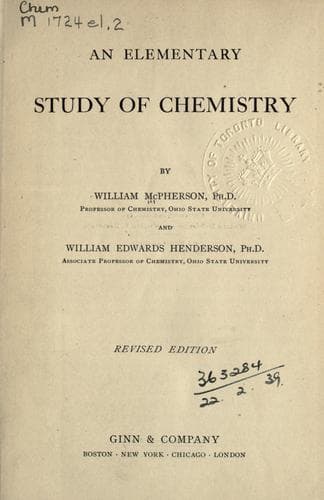
An Elementary Study of ChemistryMcPherson, William
Science
An Elementary Study of Chemistry
McPherson, William
Chemistry
According to this table copper will precipitate bismuth, mercury,
silver, or gold from their salts, and will in turn be precipitated by
zinc, iron, tin, or lead. Advantage is taken of this principle in the
purification of some of the metals, and occasionally in the preparation
of metals and their compounds.
~Important insoluble compounds.~ Since precipitates play so important a
part in the reactions which substances undergo, as well as in the
preparation of many chemical compounds, it is important to know what
substances are insoluble. Knowing this, we can in many cases predict
reactions under certain conditions, and are assisted in devising ways to
prepare desired compounds. While there is no general rule which will
enable one to foretell the solubility of any given compound,
nevertheless a few general statements can be made which will be of much
assistance.
1. _Hydroxides._ All hydroxides are insoluble save those of ammonium,
sodium, potassium, calcium, barium, and strontium.
2. _Nitrates._ All nitrates are soluble in water.
3. _Chlorides._ All chlorides are soluble save silver and mercurous
chlorides. (Lead chloride is but slightly soluble.)
4. _Sulphates._ All sulphates are soluble save those of barium,
strontium, and lead. (Sulphates of silver and calcium are only
moderately soluble.)
5. _Sulphides._ All sulphides are insoluble save those of ammonium,
sodium, and potassium. The sulphides of calcium, barium, strontium, and
magnesium are insoluble in water, but are changed by hydrolysis into
acid sulphides which are soluble. On this account they cannot be
prepared by precipitation.
6. _Carbonates, phosphates, and silicates._ All normal carbonates,
phosphates, and silicates are insoluble save those of ammonium, sodium
and potassium.
EXERCISES
1. Write equations representing four different ways for preparing
Cu(NO_{3})_{2}.
2. Write equations representing six different ways for preparing
ZnSO_{4}.
3. Write equations for two reactions to illustrate each of the three
ways in which reactions in solutions may become complete.
4. Give one or more methods for preparing each of the following
compounds: CaCl_{2}, PbCl_{2}, BaSO_{4}, CaCO_{3}, (NH_{4})_{2}S,
Ag_{2}S, PbO, Cu(OH)_{2} (for solubilities, see last paragraph of
chapter). State in each case the general principle involved in the
method of preparation chosen.
CHAPTER XXIII
THE ALKALI METALS
Public-domain text, read in full here on John Shaqi.
Reviews
Reviews
No reviews yet
Be the first to share your thoughts on this work.
Elsewhere in the archive
Join the Discussion
Join the discussion
Sign in to leave a comment or review.
Sign InorCreate an account