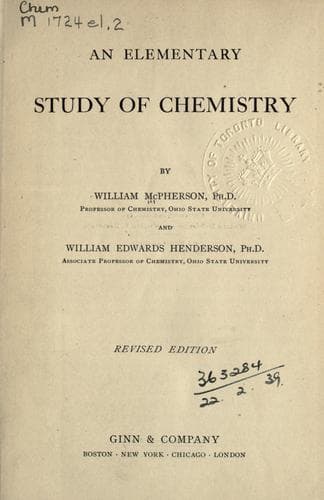
An Elementary Study of ChemistryMcPherson, William
Science
An Elementary Study of Chemistry
McPherson, William
Chemistry
~Properties of sodium carbonate.~ Sodium carbonate forms large crystals of
the formula Na_{2}CO_{3} . 10 H_{2}O. It has a mild alkaline reaction
and is used for laundry purposes under the name of washing soda. Mere
mention of the fact that it is used in the manufacture of glass, soap,
and many chemical reagents will indicate its importance in the
industries. It is one of the few soluble carbonates.
~Sodium hydrogen carbonate~ (_bicarbonate of soda_) (NaHCO_{3}). This
salt, commonly called bicarbonate of soda, or baking soda, is made by
the Solvay process, as explained above, or by passing carbon dioxide
into strong solutions of sodium carbonate:
Na_{2}CO_{3} + H_{2}O + CO_{2} = 2NaHCO_{3}.
The bicarbonate, being sparingly soluble, crystallizes out. A mixture of
the bicarbonate with some substance (the compound known as cream of
tartar is generally used) which slowly reacts with it, liberating carbon
dioxide, is used largely in baking. The carbon dioxide generated forces
its way through the dough, thus making it porous and light.
~Sodium nitrate~ (_Chili saltpeter_) (NaNO_{3}). This substance is found
in nature in arid regions in a number of places, where it has been
formed apparently by the decay of organic substances in the presence of
air and sodium salts. The largest deposits are in Chili, and most of the
nitrate of commerce comes from that country. Smaller deposits occur in
California and Nevada. The commercial salt is prepared by dissolving the
crude nitrate in water, allowing the insoluble earthy materials to
settle, and evaporating the clear solution so obtained to
crystallization. The soluble impurities remain for the most part in the
mother liquors.
Since this salt is the only nitrate found extensively in nature, it is
the material from which other nitrates as well as nitric acid are
prepared. It is used in enormous quantities in the manufacture of
sulphuric acid and potassium nitrate, and as a fertilizer.
~Sodium phosphate~ (Na_{2}HPO_{4}.12H_{2}O). Since phosphoric acid has
three replaceable hydrogen atoms, three sodium phosphates are
possible,--two acid salts and one normal. All three can be made without
difficulty, but disodium phosphate is the only one which is largely
used, and is the salt which is commonly called sodium phosphate. It is
made by the action of phosphoric acid on sodium carbonate:
Na_{2}CO_{3} + H_{3}PO_{4} = Na_{2}HPO_{4} + CO_{2} + H_{2}O.
It is interesting as being one of the few phosphates which are soluble
in water, and is the salt commonly used when a soluble phosphate is
needed.
~Normal sodium phosphate~ (Na_{3}PO_{4}). Although this is a normal salt
its solution has a strongly alkaline reaction. This is due to the fact
that the salt hydrolyzes in solution into sodium hydroxide and disodium
phosphate, as represented in the equation
Na_{3}PO_{4} + H_{2}O = Na_{2}HPO_{4} + NaOH.
Public-domain text, read in full here on John Shaqi.
Reviews
Reviews
No reviews yet
Be the first to share your thoughts on this work.
Elsewhere in the archive
Join the Discussion
Join the discussion
Sign in to leave a comment or review.
Sign InorCreate an account