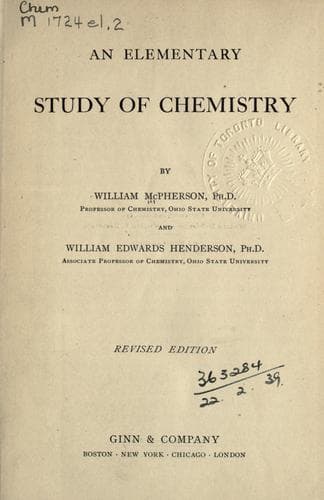
An Elementary Study of ChemistryMcPherson, William
Science
An Elementary Study of Chemistry
McPherson, William
Chemistry
~General.~ As explained in a previous chapter, when ammonia is passed into
water the two compounds combine to form the base NH_{4}OH, known as
ammonium hydroxide. When this base is neutralized with acids there are
formed the corresponding salts, known as the ammonium salts. Since the
ammonium group is univalent, ammonium salts resemble those of the alkali
metals in formulas; they also resemble the latter salts very much in
their chemical properties, and may be conveniently described in
connection with them. Among the ammonium salts the chloride, sulphate,
carbonate, and sulphide are the most familiar.
~Ammonium chloride~ (_sal ammoniac_) (NH_{4}Cl). This substance is
obtained by neutralizing ammonium hydroxide with hydrochloric acid. It
is a colorless substance crystallizing in fine needles, and, like most
ammonium salts, is very soluble in water. When placed in a tube and
heated strongly it decomposes into hydrochloric acid and ammonia. When
these gases reach a cooler portion of the tube they at once recombine,
and the resulting ammonium chloride is deposited on the sides of the
tube. In this way the salt can be separated from nonvolatile impurities.
Ammonium chloride is sometimes used in preparation of ammonia; it is
also used in making dry batteries and in the laboratory as a chemical
reagent.
~Ammonium sulphate~ ((NH_{4})_{2}SO_{4}). This salt resembles the chloride
very closely, and, being cheaper, is used in place of it when possible.
It is used in large quantity as a fertilizer, the nitrogen which it
contains being a very valuable food for plants.
~Ammonium carbonate~ ((NH_{4})_{2}CO_{3}). This salt, as well as the acid
carbonate (NH_{4}HCO_{3}), is used as a chemical reagent. They are
colorless solids, freely soluble in water. The normal carbonate is made
by heating ammonium chloride with powdered limestone (calcium
carbonate), the ammonium carbonate being obtained as a sublimate in
compact hard masses:
2NH_{4}Cl + CaCO_{3} = (NH_{4})_{2}CO_{3} + CaCl_{2}.
The salt always smells of ammonia, since it slowly decomposes, as shown
in the equation
(NH_{4})_{2}CO_{3} = NH_{4}HCO_{3} + NH_{3}.
The acid carbonate, or bicarbonate, is prepared by saturating a solution
of ammonium hydroxide with carbon dioxide:
NH_{4}OH + CO_{2} = NH_{4}HCO_{3}.
It is a well-crystallized stable substance.
~Ammonium sulphide~ ((NH_{4})_{2}S). Ammonium sulphide is prepared by the
action of hydrosulphuric acid upon ammonium hydroxide:
2NH_{4}OH + H_{2}S = (NH_{4})_{2}S + 2H_{2}O.
If the action is allowed to continue until no more hydrosulphuric acid
is absorbed, the product is the acid sulphide, sometimes called the
hydrosulphide:
NH_{4}OH + H_{2}S = NH_{4}HS + H_{2}O.
If equal amounts of ammonium hydroxide and ammonium acid sulphide are
brought together, the normal sulphide is formed:
NH_{4}OH + NH_{4}HS = (NH_{4})_{2}S + H_{2}O
Public-domain text, read in full here on John Shaqi.
Reviews
Reviews
No reviews yet
Be the first to share your thoughts on this work.
Elsewhere in the archive
Join the Discussion
Join the discussion
Sign in to leave a comment or review.
Sign InorCreate an account