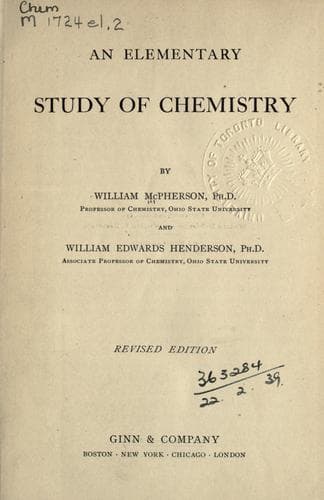
An Elementary Study of ChemistryMcPherson, William
Science
An Elementary Study of Chemistry
McPherson, William
Chemistry
When prepared in this way it is a soft white powder often called
precipitated chalk, and is much used as a polishing powder. It is
insoluble in water, but dissolves in water saturated with carbon
dioxide, owing to the formation of the acid calcium carbonate which is
slightly soluble:
CaCO_{3} + H_{2}CO_{3} = Ca(HCO_{3})_{2}.
The natural varieties of calcium carbonate find many uses, such as in
the preparation of lime and carbon dioxide; in metallurgical operations,
especially in the blast furnaces; in the manufacture of soda, glass, and
crayon (which, in addition to chalk, usually contains clay and calcium
sulphate); for building stone and ballast for roads.
~Calcium chloride~ (CaCl_{2}). This salt occurs in considerable quantity
in sea water. It is obtained as a by-product in many technical
processes, as in the Solvay soda process. When crystallized from its
saturated solutions it forms colorless needles of the composition
CaCl_{2}.6H_{2}O. By evaporating a solution to dryness and heating to a
moderate temperature calcium chloride is obtained anhydrous as a white
porous mass. In this condition it absorbs water with great energy and is
a valuable drying agent.
~Bleaching powder~ (CaOCl_{2}). When chlorine acts upon a solution of
calcium hydroxide the reaction is similar to that which occurs between
chlorine and potassium hydroxide:
2 Ca(OH)_{2} + 4 Cl = CaCl_{2} + Ca(ClO)_{2} + 2 H_{2}O.
If, however, chlorine is conducted over calcium hydroxide in the form of
a dry powder, it is absorbed and a substance is formed which appears to
have the composition represented in the formula CaOCl_{2}. This
substance is called bleaching powder, or hypochlorite of lime. It is
probably the calcium salt of both hydrochloric and hypochlorous acids,
so that its structure is represented by the formula
/ClO
Ca
\Cl.
In solution this substance acts exactly like a mixture of calcium
chloride (CaCl_{2}) and calcium hypochlorite (Ca(ClO)_{2}), since it
dissociates to form the ions Ca^{++}, Cl^{-}, and ClO^{-}.
Bleaching powder undergoes a number of reactions which make it an
important substance.
1. When treated with an acid it evolves chlorine:
/ClO
Ca + H_{2}SO_{4} = CaSO_{4} + HCl + HClO,
\Cl
HCl + HClO = H_{2}O + 2Cl.
This reaction can be employed in the preparation of chlorine, or the
nascent chlorine may be used as a bleaching agent.
2. It is slowly decomposed by the carbon dioxide of the air, yielding
calcium carbonate and chlorine:
CaOCl_{2} + CO_{2} = CaCO_{3} + 2Cl.
Owing to this slow action the substance is a good disinfectant.
3. When its solution is boiled the substance breaks down into calcium
chloride and chlorate:
6CaOCl_{2} = 5CaCl_{2} + Ca(ClO_{3})_{2}.
This reaction is used in the preparation of potassium chlorate.
Public-domain text, read in full here on John Shaqi.
Reviews
Reviews
No reviews yet
Be the first to share your thoughts on this work.
Elsewhere in the archive
Join the Discussion
Join the discussion
Sign in to leave a comment or review.
Sign InorCreate an account