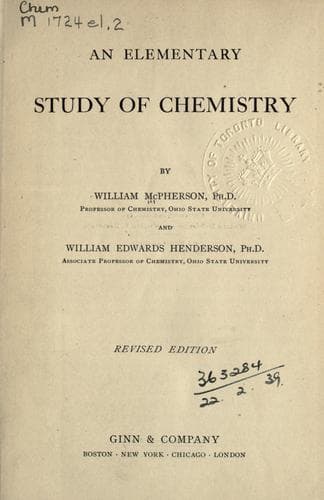
An Elementary Study of ChemistryMcPherson, William
Science
An Elementary Study of Chemistry
McPherson, William
Chemistry
~Radium and the atomic theory.~ If these views in regard to radium should
prove to be well founded, it will be necessary to modify in some
respects the conception of the atom as developed in a former chapter.
The atom would have to be regarded as a compound unit made up of several
parts. In a few cases, as in radium and uranium, it would appear that
this unit is unstable and undergoes transformation into more stable
combinations. This modification would not, in any essential way, be at
variance with the atomic theory as propounded by Dalton.
EXERCISES
1. What properties have the alkaline-earth metals in common with the
alkali metals? In what respects do they differ?
2. Write the equation for the reaction between calcium carbide and
water.
3. For what is calcium chlorate used?
4. Could limestone be completely decomposed if heated in a closed
vessel?
5. Caves often occur in limestone. Account for their formation.
6. What is the significance of the term fluorspar? (Consult dictionary.)
7. Could calcium chloride be used in place of barium chloride in testing
for sulphates?
8. What weight of water is necessary to slake the lime obtained from 1
ton of pure calcium carbonate?
9. What weight of gypsum is necessary in the preparation of 1 ton of
plaster of Paris?
10. Write equations to represent the reactions involved in the
preparation of strontium hydroxide and strontium nitrate from
strontianite.
11. Write equations to represent the reactions involved in the
preparation of barium chloride from heavy spar.
12. Could barium hydroxide be used in place of calcium hydroxide in
testing for carbon dioxide?
CHAPTER XXV
THE MAGNESIUM FAMILY
===========================================================================
|SYMBOL |ATOMIC |DENSITY |MELTING |BOILING | OXIDE
| |WEIGHT | | POINT | POINT |
---------------------------------------------------------------------------
Magnesium | Mg | 24.36 | 1.75 | 750 deg. | 920 deg. | MgO
Zinc | Zn | 65.4 | 7.00 | 420 deg. | 950 deg. | ZnO
Cadmium | Cd |112.4 | 8.67 | 320 deg. | 778 deg. | CdO
===========================================================================
~The family.~ In the magnesium family are included the four elements:
magnesium, zinc, cadmium, and mercury. Between the first three of these
metals there is a close family resemblance, such as has been traced
between the members of the two preceding families. Mercury in some
respects is more similar to copper and will be studied in connection
with that metal.
1. _Properties._ When heated to a high temperature in the air each of
these metals combines with oxygen to form an oxide of the general
formula MO, in which M represents the metal. Magnesium decomposes
boiling water slowly, while zinc and cadmium have but little action on
it.
Public-domain text, read in full here on John Shaqi.
Reviews
Reviews
No reviews yet
Be the first to share your thoughts on this work.
Elsewhere in the archive
Join the Discussion
Join the discussion
Sign in to leave a comment or review.
Sign InorCreate an account