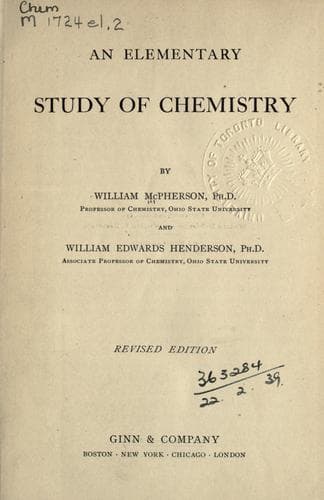
An Elementary Study of ChemistryMcPherson, William
Science
An Elementary Study of Chemistry
McPherson, William
Chemistry
15. When a solution of silver nitrate is added to a solution of
potassium chlorate no precipitate forms. How do you account for the fact
that a precipitate of silver chloride is not formed?
CHAPTER XXIX
TIN AND LEAD
====================================================================
| | | | |
| SYMBOL | ATOMIC | DENSITY | MELTING | COMMON OXIDES
| | WEIGHT | | POINT |
_____|________|________|_________|_________|________________________
| | | | |
Tin | Sn | 119.0 | 7.35 | 235 deg. | SnO SnO_{2}
Lead | Pb | 206.9 | 11.38 | 327 deg. | PbO Pb_{3}O_{4} PbO_{2}
====================================================================
~The family.~ Tin and lead, together with silicon and germanium, form a
family in Group IV of the periodic table. Silicon has been discussed
along with the non-metals, while germanium, on account of its rarity,
needs only to be mentioned.
The other family of Group IV includes carbon, already described, and a
number of rare elements.
TIN
~Occurrence.~ Tin is found in nature chiefly as the oxide (SnO_{2}),
called cassiterite or tinstone. The most famous mines are those of
Cornwall in England, and of the Malay Peninsula and East India Islands;
in small amounts tinstone is found in many other localities.
~Metallurgy.~ The metallurgy of tin is very simple. The ore, separated as
far as possible from earthy materials, is mixed with carbon and heated
in a furnace, the reduction taking place readily. The equation is
SnO_{2} + C = Sn + CO_{2}.
The metal is often purified by carefully heating it until it is partly
melted; the pure tin melts first and can be drained away from the
impurities.
~Properties.~ Pure tin, called block tin, is a soft white metal with a
silver-like appearance and luster; it melts readily (235 deg.) and is
somewhat lighter than copper, having a density of 7.3. It is quite
malleable and can be rolled out into very thin sheets, forming tin foil;
most tin foil, however, contains a good deal of lead.
Under ordinary conditions it is quite unchanged by air or moisture, but
at a high temperature it burns in air, forming the oxide SnO_{2}. Dilute
acids have no effect upon it, but concentrated acids attack it readily.
Concentrated hydrochloric acid changes it into the chloride
Sn + 2HCl = SnCl_{2} + 2H.
With sulphuric acid tin sulphate and sulphur dioxide are formed:
Sn + 2H_{2}SO_{4} = SnSO_{4} + SO_{2} + 2H_{2}O
Concentrated nitric acid oxidizes it, forming a white insoluble compound
of the formula H_{2}SnO_{3}, called metastannic acid:
3Sn + 4HNO_{3} + H_{2}O = 3H_{2}SnO_{3} + 4NO.
Public-domain text, read in full here on John Shaqi.
Reviews
Reviews
No reviews yet
Be the first to share your thoughts on this work.
Elsewhere in the archive
Join the Discussion
Join the discussion
Sign in to leave a comment or review.
Sign InorCreate an account