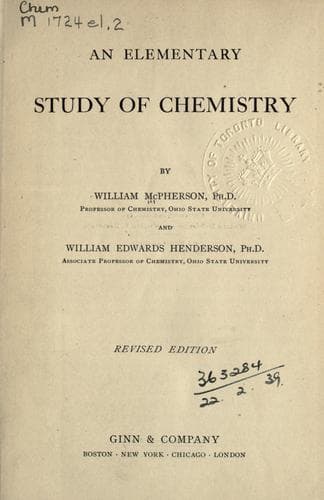
An Elementary Study of ChemistryMcPherson, William
Science
An Elementary Study of Chemistry
McPherson, William
Chemistry
8. How much lead peroxide could be obtained from 1 kg. of minium?
9. The purity of white lead is usually determined by observing the
volume of carbon dioxide given off when it is treated with an acid. What
acid should be used? On the supposition that it has the formula
2PbCO_{3}.Pb(OH)_{2}, how nearly pure was a sample if 1 g. gave 30 cc.
of carbon dioxide at 20 deg. and 750 mm.?
10. Silicon belongs in the same family with tin and lead. In what
respects are these elements similar?
11. What weight of tin could be obtained by the reduction of 1 ton of
cassiterite?
12. What reaction would you expect to take place when lead peroxide is
treated with hydrochloric acid?
13. White lead is often adulterated with barytes. Suggest a method for
detecting it, if present, in a given example of white lead.
CHAPTER XXX
MANGANESE AND CHROMIUM
====================================================================
| | | | |
| SYMBOL | ATOMIC | DENSITY | MELTING | FORMULAS OF ACIDS
| | WEIGHT | | POINT |
__________|________|________|_________|_________|___________________
| | | | |
Manganese | Mn | 55.0 | 8.01 | 1900 deg. | H_{2}MnO_{4} and
| | | | | HMnO_{4}
Chromium | Cr | 52.1 | 7.3 | 3000 deg. | H_{2}CrO_{4} and
| | | | | H_{2}Cr_{2}O_{7}
====================================================================
~General.~ Manganese and chromium, while belonging to different families,
have so many features in common in their chemical conduct that they may
be studied together with advantage. They differ from most of the
elements so far studied in that they can act either as acid-forming or
base-forming elements. As base-forming elements each of the metals forms
two series of salts. In the one series, designated by the suffix "ous,"
the metal is divalent; in the other series, designated by the suffix
"ic," the metal is trivalent. Only the manganous and the chromic salts,
however, are of importance. The acids in which these elements play the
part of a non-metal are unstable, but their salts are usually stable,
and some of them are important compounds.
MANGANESE
~Occurrence.~ Manganese is found in nature chiefly as the dioxide MnO_{2},
called pyrolusite. In smaller amounts it occurs as the oxides
Mn_{2}O_{3} and Mn_{3}O_{4}, and as the carbonate MnCO_{3}. Some iron
ores also contain manganese.
~Preparation and properties.~ The element is difficult to prepare in pure
condition and has no commercial applications. It can be prepared,
however, by reducing the oxide with aluminium powder or by the use of
the electric furnace, with carbon as the reducing agent. The metal
somewhat resembles iron in appearance, but is harder, less fusible, and
more readily acted upon by air and moisture. Acids readily dissolve it,
forming manganous salts.
Public-domain text, read in full here on John Shaqi.
Reviews
Reviews
No reviews yet
Be the first to share your thoughts on this work.
Elsewhere in the archive
Join the Discussion
Join the discussion
Sign in to leave a comment or review.
Sign InorCreate an account