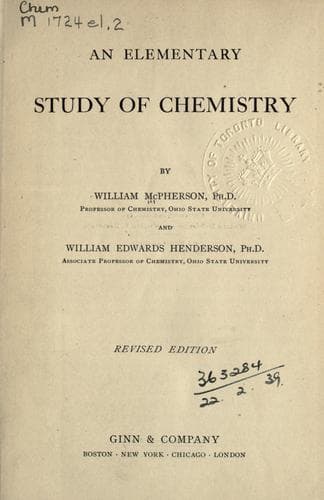
An Elementary Study of ChemistryMcPherson, William
Science
An Elementary Study of Chemistry
McPherson, William
Chemistry
Like the other classes of organic compounds, the organic acids may be
arranged in homologous series. One of the most important of these series
is the _fatty-acid series_, the name having been given to it because
the derivatives of certain of its members are constituents of the fats.
Some of the most important members of the series are given in the
following table. They are all monobasic, and this fact is expressed in
the formulas by separating the replaceable hydrogen atom from the rest
of the molecule:
H.CHO_{2} formic acid, a liquid boiling at 100 deg..
H.C_{2}H_{3}O acetic acid, a liquid boiling at 118 deg..
H.C_{3}H_{5}O_{2} propionic acid, a liquid boiling at 140 deg..
H.C_{4}H_{7}O_{2} butyric acid, a liquid boiling at 163 deg..
H.C_{16}H_{31}O_{2} palmitic acid, a solid melting at 62 deg..
H.C_{18}H_{35}O_{2} stearic acid, a solid melting at 69 deg..
~Formic acid~ (H.CHO_{2}). The name "formic" is derived from the Latin
_formica_, signifying ant. This name was given to the acid because it
was formerly obtained from a certain kind of ants. It is a colorless
liquid and occurs in many plants such as the stinging nettles. The
inflammation caused by the sting of the bee is due to formic acid.
~Acetic acid~ (H.C_{2}H_{3}O_{2}). Acetic acid is the acid present in
vinegar, the sour taste being due to it. It can be prepared by either of
the following methods.
1. _Acetic fermentation._ This consists in the change of alcohol into
acetic acid through the agency of a minute organism commonly called
mother of vinegar. The change is represented by the following equation:
C_{2}H_{5}OH + 2O = HC_{2}H_{3}O_{2} + H_{2}O.
The various kinds of vinegars are all made by this process. In the
manufacture of cider vinegar the sugar present in the cider first
undergoes alcoholic fermentation; the resulting alcohol then undergoes
acetic fermentation. The amount of acetic acid present in vinegars
varies from 3 to 6%.
2. _From the distillation of wood._ The liquid obtained by heating wood
in the absence of air contains a large amount of acetic acid, and this
can be separated readily in a pure state. This is the most economical
method for the preparation of the concentrated acid.
Acetic acid is a colorless liquid and has a strong pungent odor.
Many of its salts are well-known compounds. Lead acetate
(Pb(C_{2}H_{3}O_{2})_{2}) is the ordinary _sugar of lead_. Sodium
acetate (NaC_{2}H_{3}O_{2}) is a white solid largely used in making
chemical analyses. Copper acetate (Cu(C_{2}H_{3}O_{2})_{2}) is a blue
solid. When copper is acted upon by acetic acid in the presence of air a
green basic acetate of copper is formed. This is commonly known as
verdigris. All acetates are soluble in water.
~Butyric acid~ (H.C_{4}H_{7}O_{2}). Derivatives of butyric acid are
present in butter and impart to it its characteristic flavor.
Public-domain text, read in full here on John Shaqi.
Reviews
Reviews
No reviews yet
Be the first to share your thoughts on this work.
Elsewhere in the archive
Join the Discussion
Join the discussion
Sign in to leave a comment or review.
Sign InorCreate an account