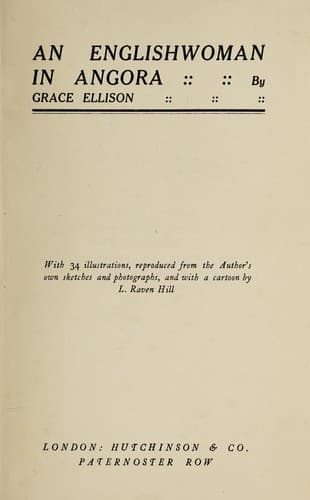
Atatürk, Kemal, 1881-1938; Turkey -- Description and travel; Turkey -- Politics and government -- 1918-1960
Kemal, in his interview, said: “I am certain we shall eventually
return to the traditional friendship between Turkey and Britain.
I can see no obstacle thereto.” With the fall of the Coalition
Government, the last obstacle has gone. Lord Curzon has been
firm with the Turks, but not venomous, frank but not insulting.
He can afford to leave rude harangues and offensive imprecations
to the congress of fallen angels now assembling at Algeciras.
Indeed, all the declarations of the Foreign Secretary go to show
that he is sincerely anxious to reach a durable and friendly
settlement with the emissaries of Angora, and that if he is
determined to uphold the rights of the British, he is equally
ready to acknowledge the independence of the Turkish Empire. We
are glad to see that Kemal is anxious to reciprocate, and
therein he shows himself to be not only a soldier but a
statesman. For his task is not yet ended; indeed it is only
beginning. He has saved his country from the Greek; he must now
save it from the moth and rust of economic decay. In that great
task he will find Great Britain his best friend. Fethi Bey has
doubtless made it clear to him how much Europe can contribute to
the economic reconstruction of Turkey, and a recent statement of
Mr. Morgenthau should convince him that the United States will
be a reluctant and difficult lender. In the long run he has to
choose between free co-operation with Great Britain and an
enslavement at the mercy of Bolshevist Russia. He seems already
to have chosen the better course; for the sake of his country,
and ours, we hope and believe that he will persist in it.
------------------------------------------------------------------------
CHAPTER XX
MUSTAPHA KEMAL PASHA—THE MAN WHO IS MASTER OF HIS FATE
MY eye fell on the portrait of a handsome Turkish lady, which was
hanging over the Pasha’s writing-desk.
“What a lovely face!” I exclaimed.
“My mother,” said the Pasha, with obvious pride.
“Would it be very indiscreet,” said I, “to ask if I might have the great
pleasure of seeing her?”
“She is very ill. The doctors are with her day and night. Alas, I fear
she can never recover.”
We afterwards went up the staircase to the invalid’s apartments. To my
surprise, we found her seated on a wide divan, supported by cushions. It
was difficult at first to believe that she was so near the end.
“Alas!” said Mustapha Kemal, “her suffering has come through me. She is
paying back now the tears and anguish she spent for me in exile.” There
was sorrow in his voice, too heart-broken for many words.
“Now you can take part in his victory,” I said. “How proud you must be
of your son. His is a wonderful story. I am proud only to have spoken
with him and seen his work.”
Public-domain text, read in full here on John Shaqi.
Reviews
Reviews
No reviews yet
Be the first to share your thoughts on this work.
Elsewhere in the archive
Join the Discussion
Join the discussion
Sign in to leave a comment or review.
Sign InorCreate an account