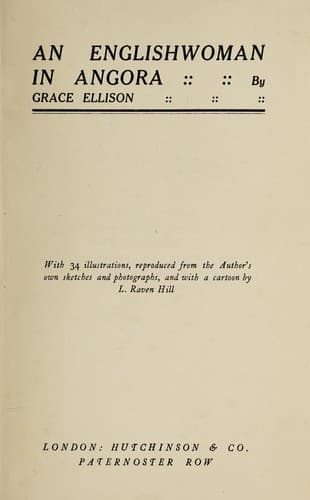
Atatürk, Kemal, 1881-1938; Turkey -- Description and travel; Turkey -- Politics and government -- 1918-1960
He was in Syria when the Armistice was signed; and returning with high
hopes to Constantinople, sank broken-hearted before the treachery of
Mudros! But not for long.
Never the man to nurse despair, he quickly rose again to his country’s
call. Offered the post of Inspector of the East (that is, High
Functionary of the Eastern Villayets), he accepted at once, and hurried
into Anatolia to prepare for resistance.
From the moment he stepped out at Samsoun, _the movement began_.
What shall we say of the “Man at the Helm—the Hero and the Genius?” Were
his “Destinies,” indeed, “written on the tablets of heaven”; or may he
not rather claim:
“I am Master of my Fate
I am Captain of my Soul”
* * * * *
Every detail of the work had to be built up, as it were, stone by stone,
entirely afresh—an army to be found anywhere and everywhere from
nothing. Yet it was trained and organised to become, what Colonel Mougin
tells me, is “the best-disciplined and best-officered army in the
world.”
Perhaps the Battle of the Sakharia, lasting fifteen days without
interruption, may be quoted as the Great Victory. It was certainly one
of the battles of this century. When one of the majors asked for
instructions about “the line provided for retreat,” he was told: “There
will be no retreat. Advance, or die in your trenches!”
On the anniversary of the Battle of the In-Enus, Ismet Pasha told me a
little about his victory, and what it meant. What victory _must_ mean
when you have nothing with which to conquer.
Already the military experts have written pages about the advance and
the victory. One day, we hope, “The Pasha” will give us his own version.
How, again, shall we tell the endurance of the people, suffering through
long years in silence and alone? To us who could but look on them,
pitying and admiring from a distance, it seemed as if someone _must_ get
through somehow to offer the hand of friendship and give, at least,
heartfelt sympathy. I tried, but it could not be done. Even now, I
cannot say all it has cost me to reach Angora!
Mustapha Kemal must put on record “The Birth of a Nation”; and from
Halidé Hanoum we want the thousand and one pictures of the agony of
simple folk—desolate village homes, women who weep _and_ work, the
little ones crying, “What is it, mother?”; all that war means to men,
all that men can endure for liberty and the right.
“What does it matter,” she has written, “though the world call us
pariah? We will die with honour. What does it matter if food be denied
us by all our neighbours? Our own soil will keep us alive, sheltered in
sackcloth!”
Public-domain text, read in full here on John Shaqi.
Reviews
Reviews
No reviews yet
Be the first to share your thoughts on this work.
Elsewhere in the archive
Join the Discussion
Join the discussion
Sign in to leave a comment or review.
Sign InorCreate an account