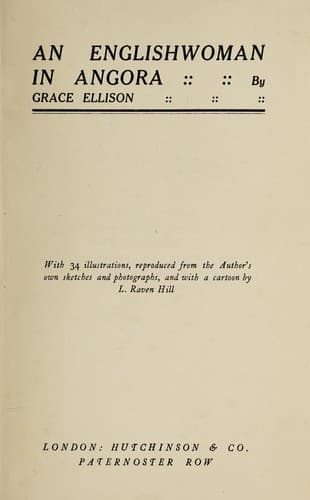
Atatürk, Kemal, 1881-1938; Turkey -- Description and travel; Turkey -- Politics and government -- 1918-1960
Sarojini Naidu, also a friend of Halidé Hanoum, sent me an exquisite
poem during the world’s despair. As the words went perfectly to the tune
of “Rose in the Bud,” I have sung them again and again for conquest in
sorrow, and rejoiced in their magic power. To those yearning for higher
things, to whom words of faith bring comfort amidst the cold angles of
life, the little poem may have its message:
Nay, do not weep tho’ life be full of sadness;
Dawn will not veil her splendour for your grief,
Nor spring withhold that bright appointed beauty
From lily’s blossom or Ashaka leaf.
Nay, do not pine tho’ life be full of trouble;
Time will not pause nor tarry on his way.
To-day that seems so long, so strange, so bitter,
Will soon be some forgotten yesterday.
Nay, do not weep—new hopes—new dreams—new faces,
The unspent joy of all the unborn years,
Will prove your heart a traitor to its sorrow
And make your eyes unfaithful to their tears.
SAROJINI NAIDU.
After the Constitution of 1918 had been proclaimed, “Freedom for Women”
became one of the burning questions of the day. Here, Halidé Hanoum was
almost immediately the acknowledged leader, and has ever since been
urging her sisters, with noble eloquence, to take the position so long
denied them in the life of the country. With her solid backing from
Talaat and Djémal, Djavid and H. Djahid, she achieved wonders of
awakening. In those old days I had myself contributed to some of the
excellent women’s papers, which were brought out for the discussion of
educational and social problems, among which I regret to have seen no
more of that most promising sheet, the _Kadinlar Dunyassi_. At the
request of the Department of Public Instruction, Halidé Hanoum drew up a
programme of Education for Women and was herself appointed Chief
Inspector of Schools.
By the letter of the law at least, Turkish women are in a much better
position than women have yet secured among us—to the disgrace of Western
liberty. They have always administered their own property, signed all
documents relating to their own affairs, have the full privileges of a
witness in the courts, and are allowed to plead their own cases—we have
not.
They were, unfortunately, kept back socially during the retrograde
régime of the ruthless Hamid; but their fine work on the battle-fields
of the Balkan wars, side by side in the ranks with their men, and their
able organisation of the Red Crescent Society, carried them forward _a
hundred years_.
Public-domain text, read in full here on John Shaqi.
Reviews
Reviews
No reviews yet
Be the first to share your thoughts on this work.
Elsewhere in the archive
Join the Discussion
Join the discussion
Sign in to leave a comment or review.
Sign InorCreate an account