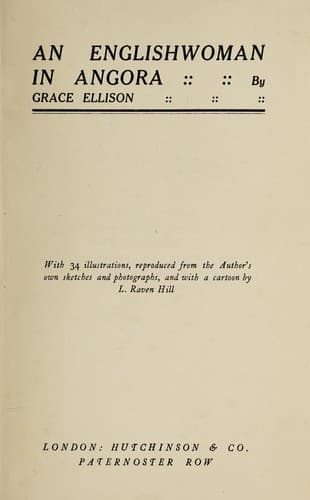
Atatürk, Kemal, 1881-1938; Turkey -- Description and travel; Turkey -- Politics and government -- 1918-1960
Hussein Raghib himself has published a very delightful “Story of
Nationalism,” dating from the Closing of the Turkish Parliament. “As a
matter of fact,” he writes, “the _Turc Odjagui_ was the beginning of
Nationalism.” This was a club founded by Hamdoullah Soubhi Bey as a
protest against “Union and Progress,” and to place the movement on a
national, as opposed to a party, basis. Halidé Hanoum and other
prominent women were admitted; and its three thousand members included
professional men like officers, lawyers, doctors, professors and
writers; and men of all nationalities—Greeks and Armenians, Persians and
Arabs. It was closed by the English, but has recently been re-assembled.
Mustapha Kemal Pasha contributed handsomely to the funds, and Hamdoullah
Soubhi came from Angora for the re-opening. “As our territory has become
smaller, our intellectual empire must become wider,” said Hussein
Raghib. “That is the spirit behind the club.” I had, unfortunately, to
leave for Lausanne before the opening ceremony.
* * * * *
I have just been to the famous Hadgi Bairam Mosque, and found its chief
charm, as I expected, in the exquisite colouring of the carpets and
antique faïences. These glowing scarlets and blues, mauves and
terra-cottas, surely compensate, in some measure, for all the grey that
overshadows life. Europe would not seem so sordid if we imported more
bright colours from the East—for our _East_ Ends! Nothing fascinates me
so much as the atmosphere of a mosque; the un-selfconsciousness and
natural reverence of the men at prayers; out of the world, in Allah’s
home.
Surely faith is the same for all men, making all men equal!
“The gods,” said my guide, “are three—Goodness, Beauty, and Truth.”
“To which I would add Courage,” was my response.
“As you please,” he answered.
He told me that “The Pasha” and the first Deputies all came to visit the
Mosque before the opening of the Grand National Assembly, joined by
everyone in Angora—even sceptics—“to lift our hands to Heaven in prayer,
confident that victory must be ours.”
We went on to the tomb of the Sainted Man, robed in shawl and turban,
after the picturesque Eastern manner. The guardian of the tomb was
seated before it on his crossed legs, reading the Koran; and around him
were many women, weeping over their prayers.... “Is it for peace, or for
their dead?” I wondered!
* * * * *
That afternoon I determined to try and find out all I could about the
army from some of my friends at the Assembly.
“You are very indiscreet,” said the officer, whose attention I had
managed to secure.
“I know that,” was my reply; “it is a little like asking St. Peter for
just a peep into Heaven. But you _can_ tell me something?”
“What do you wish to know? Our normal military service is for three
years. We naturally have to adopt conscription for an indefinite period
in times of war.”
Public-domain text, read in full here on John Shaqi.
Reviews
Reviews
No reviews yet
Be the first to share your thoughts on this work.
Elsewhere in the archive
Join the Discussion
Join the discussion
Sign in to leave a comment or review.
Sign InorCreate an account