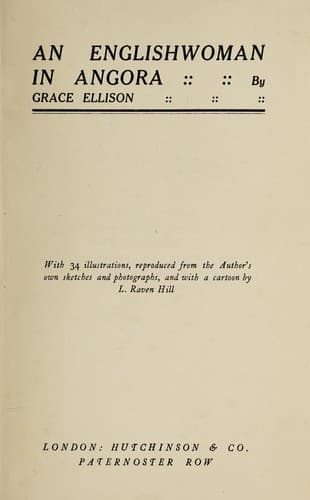
Atatürk, Kemal, 1881-1938; Turkey -- Description and travel; Turkey -- Politics and government -- 1918-1960
I complimented Djellal Noury upon the excellence of his French. “I used
to edit a French paper,” he replied, as he looked round the ante-room in
search of anyone to whom I might especially like to be introduced. For
my part, my attention had just been caught by one of the hodjas.
“These people do not think as we do,” he said, catching the direction of
my glance.
“Then you are anti-Islam?”
“Not at all; I am strongly _pro_-Islam. The broad-minded dogmas of our
religion can meet all modern requirements, moral or spiritual. But the
Koran is not properly interpreted by the hodjas. The will of the people
is our religion; service is worship!”
I remember a story of Mahomet I heard in Turkey. “The prophet was one
day walking with his disciples, and passed a group of workmen on the
river’s bank who did not stop their task, even to salute him. When his
disciples inquired whether these men should not be called to order, he
replied: ‘Work and service are the greatest homage that the faithful can
pay to their prophet.’”
I had already conceived the idea that Nationalism is a religion. One
sees the National Pact beside the bedside, as we have our prayer-books.
Colonel Tewfik has a copy, bound like a small almanac, in his waistcoat
pocket. The principles of Angora are their “Holy Gospel.” To be a
Nationalist is to stand for your country’s most vital interests.
We spoke of the Press—Turkish as well as British. The whole Turkish
Press stands for Nationalism, irrespective of any opposed local opinions
or interests. With us, the fine independence of other days has
departed—one hopes not for ever. In the hands of a few party-peers one
could, perhaps, expect nothing better. Were it not anti-Islam, one would
name the _Manchester Guardian_ as the most honest newspaper to-day.
Djellal Noury had given up so many afternoons to explaining to me the
whole policy of Nationalism, that I was grieved to hear of his having
called to see me one afternoon when a party had been arranged for me by
the colonel to join one of their shooting expeditions. I wish he could
have been persuaded to join us.
A special carriage and two of the finest horses in Angora had been
requisitioned for the occasion; and though the colonel was prevented, at
the last moment, from being with us, we made up four guns, and every man
had two rows of cartridges round his waist.
I had visions of our coming Sunday lunch; but, alas! it was bitterly
cold (in spite of rugs and shawls) on these lovely and picturesque
roads, white with frost; and when we had waited a whole afternoon for
the shooters to shoot, someone at last bagged a magpie.
Passing a flock of geese, by which the old woman of a tiny roadside farm
was standing sentinel, I asked one of the party to hand me a gun with
which to shoot one of the geese by mistake. I remembered in time,
however, that the only time I had ever aimed at a rabbit, I killed a
fox; and I was afraid that by aiming at the goose I should probably
shoot the lady.
Public-domain text, read in full here on John Shaqi.
Reviews
Reviews
No reviews yet
Be the first to share your thoughts on this work.
Elsewhere in the archive
Join the Discussion
Join the discussion
Sign in to leave a comment or review.
Sign InorCreate an account