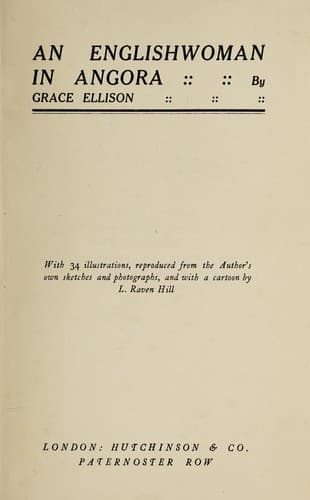
Atatürk, Kemal, 1881-1938; Turkey -- Description and travel; Turkey -- Politics and government -- 1918-1960
Monsignor X. has come to fetch me. He, too, is keenly interested in
Angora. Now I am taken to the Throne Room; the Holy Father comes forward
to greet me. He stands whilst talking to me, with one hand resting on a
large piece of antique furniture. Beginning to speak in English, he
continues in French.
The Pope speaks most modern languages; and, as he receives every day,
keeps himself in personal touch not only with the best-known Catholics,
but with all the important personalities who come to Rome. He has
travelled extensively, is well-read in many languages, and has written
books of the highest value. As a younger man, Monsignor Ceretti—the
Paris Papal Nonce—has told us, the Pope used often to read and write the
whole night through, and he has an inexhaustible fund of most valuable
information. And what does he not know of Islam? He has studied it in
all its phases; hence his great tolerance.
Clad in a white cloth soutane, with a wide white cape over his broad
shoulders, a white cloth sash hanging in wide ends on the left side,
white buttons and a white calotte and red shoes, the Holy Father stands
out as a contrast in simplicity to his surroundings. His thick gold
chain and handsomely chiselled cross, with its large diamonds, are his
only ornaments besides the pastoral ring.
Of medium height and pale, his powerful face is young for his years, and
his large wide forehead quite unlined. His features are clear cut; his
eyes seem small, perhaps because of the thick glass of the spectacles,
which he frequently adjusts.
One is particularly struck, however, by the power of his features and
his frank expression. It is a face of much intelligence, but, above all,
one of the greatest human kindness. This can be seen more from the mouth
than the eyes.
I told the Pope why I was going to Angora, where, as the people knew me
and trusted me, I hoped, at any rate, to achieve some good. An
expression of infinite sadness passed over his face as I continued: “All
this awful bloodshed, this useless suffering. Surely these things should
never have come upon us.”
There was, indeed, little his Holiness could say. He knows how useless
it is now, to question on whose shoulders History will place the
responsibility for the diplomatic bungling in the Near East.
It should be remembered, however, that he had written to M. Kemal,
begging him to do all in his power to prevent bloodshed as the army
advanced. The Pasha’s reply was dignified, wise, and sympathetic: surely
a key to his fine personality, as all can recognise it to-day.
Public-domain text, read in full here on John Shaqi.
Reviews
Reviews
No reviews yet
Be the first to share your thoughts on this work.
Elsewhere in the archive
Join the Discussion
Join the discussion
Sign in to leave a comment or review.
Sign InorCreate an account