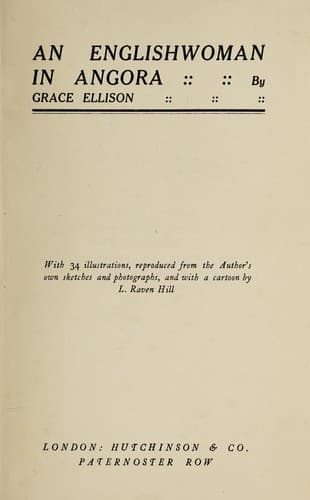
Atatürk, Kemal, 1881-1938; Turkey -- Description and travel; Turkey -- Politics and government -- 1918-1960
In a ring formed round a centre of blazing torches, white-robed men wail
and mourn for the holy martyr, slashing their heads with swords. They
dip their hands in the flowing blood, and sprinkle it all over their
faces. I was haunted for weeks by the ghastly spectacle, which I shall
never be able to forget, of those stained robes and faces, amidst the
wild fanatical shrieks. When, as often happens, a man thus kills himself
in the fury of exaltation, he is acclaimed a martyr, and his family are
pensioned for life.
When I asked why such awful ceremonies were permitted, I was reminded of
Turkey’s “non-interference” with every creed and all the “pieties” of
all peoples.
* * * * *
At Rome, I lodged in a quiet convent, which closed at 7.30. But the
Ambassador called at eight and was followed by a succession of Turkish
friends, until Mihrinour and her husband arrived at 10.30. I apologised
next morning to the Mother Superior for such unseemly interruptions of
her ordered life; explaining, in a fifteen minutes’ lecture, how anxious
a Turk would always feel for the comfort of any friend. “You are
perfectly right,” she said, “I know them well. I lived eighteen years on
the shores of the Bosphorus!”
Djelaleddine Arif Bey gave me a right royal welcome to Rome, and allowed
me to trouble him with all sorts of questions. In Constantinople he had
been what we call Dean of the Faculty of Law, and one day, on an
official visit to the Sultan, wearing a frock-coat and patent-leather
shoes, _he had just time to escape to Angora_, dressed as he was. His
knowledge of both the Cheriat and European Laws was invaluable to the
Assembly, and it is a delight to hear from his own lips that Turkey is
going to establish her _own_ Constitution, not a poor imitation of ours.
“Our justice has been paralysed by capitulations,” he said; and told me
of an Italian murderer who had found sanctuary in his Consulate, because
the Kavass would not give him up. “We have been bound and fettered all
these years, but it cannot go on.”
His admirable organisation of Justice in Angora developed from one
colleague to twenty-five assistants, for work which occupied three
hundred men in Constantinople! Yet he very soon established complete
order, though after the peace he hopes for still greater perfection.
He was interested in the personality of Cardinal Gasparri, whom I had
met for the first time. I found him a great contrast to Cardinal Merry
de Val, with whom I had long discussions about Islam ten years ago.
Public-domain text, read in full here on John Shaqi.
Reviews
Reviews
No reviews yet
Be the first to share your thoughts on this work.
Elsewhere in the archive
Join the Discussion
Join the discussion
Sign in to leave a comment or review.
Sign InorCreate an account