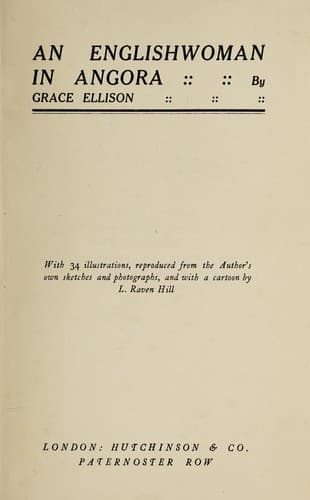
Atatürk, Kemal, 1881-1938; Turkey -- Description and travel; Turkey -- Politics and government -- 1918-1960
I have never been able to understand why anyone should be so afraid of
the Cheriat Laws. With all respect for my present company, I say, what I
afterwards repeated to Sir William Tyrell, “I would rather trust myself
in a Turkish court than appeal to American justice.” In the first case,
you may find yourself in the hands of a kind-hearted judge; the second
adventure depends entirely on cash. English justice has no equal; but
our laws for women are themselves unjust, and the best workman can do
little with poor material. Trials, like marriages in foreign countries,
should be illegal unless the Consul, or someone equally expert, is
present to “watch for” his fellow-countryman. What crimes have not we
committed in the name of Justice through ignorance of foreign customs!
“Those who face the choice of trusting themselves to the Cheriat or
keeping away from Turkey, may find that these laws are not so terrible
after all,” answered the American.
Zeyneb once said that the great merit of Moslem “Commandments” was the
absence of mystery. “The i’s are all carefully dotted. We are not told,
for instance, that we should give to the poor; we _are_ told the precise
percentage of income that must be allotted to charity. Though our laws
come from the great Prophet of Allah they are not ecclesiastical.”
In Moslem countries the Head of the State must be elected by the people;
he has full executive and legislative power, but he is also personally
responsible to the nation. We cannot deny that Mustapha Kemal Pasha has
rigidly adhered to this theory of government in his daily practice.
This is the true Democracy. Born without any advantages of caste or
family, Fethi Bey laughs at all my allusions to “old ancestors.” The
attitude does seem peculiar to Western minds, and may often lead to
confusion between us, but it is not without charm.
“How do these very intelligent, modern Turks attempt to reconcile their
zeal for liberal reform with their firm loyalty to Islam? How do they
account for the decline in prestige and power that none can deny has
been their fate?”
“My friends at the Assembly attribute the temporary fall of Turkey to
the strong, non-progressive, influence of the hodjas, who have converted
themselves into a powerful priestly class, as forbidden by the Prophet.
Others attribute it to ignorance of economics; others to Western
remoulding of Islam, and foreign oppression; others still, to a
perpetual state of war.”
“What is the Pasha’s personal opinion?”
Public-domain text, read in full here on John Shaqi.
Reviews
Reviews
No reviews yet
Be the first to share your thoughts on this work.
Elsewhere in the archive
Join the Discussion
Join the discussion
Sign in to leave a comment or review.
Sign InorCreate an account