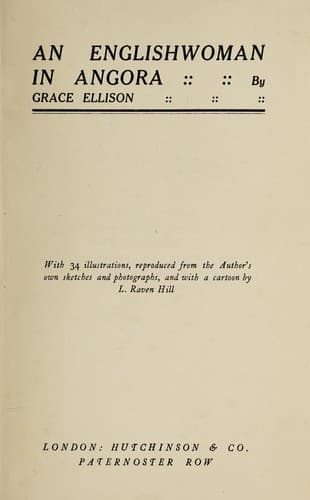
Atatürk, Kemal, 1881-1938; Turkey -- Description and travel; Turkey -- Politics and government -- 1918-1960
“He is my brother,” she replied in excellent English, obviously
delighted. It appears she had lost touch with him for many years; only
knowing that he had been in prison and escaped to join Mustapha Kemal.
Now she hoped he must be coming into his own again.
I was glad to tell her how greatly we appreciated Dr. Réchad in London.
Our acquaintance brought me many new pleasures in Broussa, in addition
to her own delightful society and her most friendly baby. She introduced
me to many of the nicest people in the hotel, and arranged for us to
visit the admirable hospitals of Dr. Nazoum, head of the Army Medical
Service, who was a friend of her husband’s.
There were two Turkish gentlemen, however (General Kemallidine Pasha and
Nourredine Pasha), whom I had been warned _not to see_, because they
were “such bears and hated England”; naturally, having thus had my
combative curiosity excited, I eagerly sought for introductions to them.
And I could not admit the justice of their condemnation.
General Kemallidine Pasha is about thirty-five, with an honest, open
face and merry eyes, that strongly reminded me of my brother; who—though
not wounded _eighteen times_ like the Pasha—has been so frequently sewn
up as to present to the world, so I tell him, no more than a figure of
“threads and patches.” He apologised for offering his left hand,
obviously pleased when I said, “it did not matter which of a hero’s
hands one is privileged to shake.” When I said that I was sorry to hear
he disliked my country, he gave the only explanation I ever obtained
from a Turk: “It is because I once loved her so well!”
And for that I have only one answer, provided for me by Mr. D——, who was
in Constantinople all through the war, and is convinced that the English
were, throughout, entirely misled by Greek and Armenian dragomen. He,
himself, would never trust these men to translate any newspaper article
for him. “Their work may be, and frequently is, quite correct, but they
are clever enough to impart an entirely different _meaning_ from one
language to the other; for example, with the word “iltehoc,” how can
that word be translated with all its shades of meaning?
“The most dangerous Englishmen,” he said, “were irresponsible young
colonels of twenty-five, the familiar “temporary gentlemen,” whose
sudden access to power and responsibility has, on other occasions, led
Great Britain into adventures she cannot, afterwards, disown. One must
regret, but can scarcely in fairness condemn, some of these brave boys
from the “edge of beyond” in Canada or Australia, who, of course, are
absolutely ignorant of Moslem customs, and, by training, rather
aggressively impatient of the slow ways of old England herself.
There were Turks of a very inferior type to be found to help them, as it
would be dishonest to deny. Those who made themselves _personna grata_
to the Allies, and enemies to the Nationalists, because they would sink
to any calumny or blackmail to secure a “job,” or to keep one.
Public-domain text, read in full here on John Shaqi.
Reviews
Reviews
No reviews yet
Be the first to share your thoughts on this work.
Elsewhere in the archive
Join the Discussion
Join the discussion
Sign in to leave a comment or review.
Sign InorCreate an account