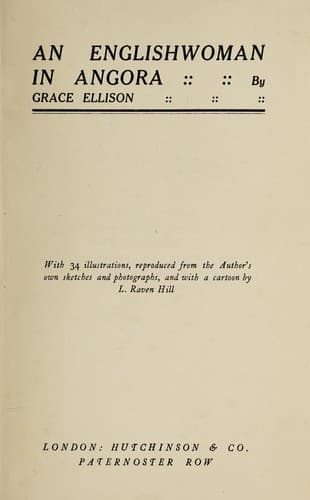
Atatürk, Kemal, 1881-1938; Turkey -- Description and travel; Turkey -- Politics and government -- 1918-1960
It was about half-past six in the evening when we were summoned to
embark; and there was no sign of the “special cabin” that had been
promised me in this little cockle-shell of a boat, on which passengers,
nevertheless, are divided according to class. For my part, I chose to
travel second, as there was far more air; and, as we opened the door,
the “poultry yard” gave us a hearty welcome! The women had taken their
chickens and rabbits into their berths; the floor was strewn with corn
and lettuce-leaves! As I disliked sharing my bed with poultry, I should
be happier in the cold outside.
However, the first officer graciously gives up his cabin. It is tiny, by
no means immaculate, and papered with cheerful postcards. But, in the
place of honour, Queen of Beauty among the ladies of the Levant, hangs
Gladys Cooper! I have never so much admired that lovely actress as when
now she seemed smiling down at my mighty efforts to sleep in this
tiniest of bunks that had been built for someone of half my length and
width.
The little tub ultimately started at midnight, dancing over the waves to
Constantinople, where Turkish passports are no protection, and I must
now learn to depend on my credentials from England.
* * * * *
What is going to happen to me? Very possibly my passport will be taken
from me, or endorsed with the grim words “not to return to England.”
My mission, indeed, was harmless, if not sanctioned. I have, honestly,
endeavoured to see that England may be “a little better” understood by
the Nationalists in Anatolia. But in fighting Prussianism, we have been
slightly infected by that disease. It has crept into our legislation and
our administration. In free England, Cæsar reigns. We can say, as the
Turks say, “We have _Prussia_ to thank for our distress.”
------------------------------------------------------------------------
CHAPTER XXXII
CONSTANTINOPLE NO LONGER THE CAPITAL—THE HEART AND SPIRIT OF TURKEY ARE
IN ANGORA
AS our little cockle-shell reaches the busy quay at Constantinople, the
veiled women collect their animals and carry them through the Custom
house. I am the only Britisher, yet the tall, well-built official
rapidly scans my passport and signs it without moving a muscle, or
showing the faintest surprise at my arrival by _that boat_, not even
opening his lips in reply to my good-morning. Is this army etiquette?
His kind face has been taught not to unbend. It seems a foolish way of
encouraging foreigners to understand us. “You are not English,” everyone
declares, “dear lady, you have too much heart to be English.”
“We English have hearts,” is my reply, “but, for some reason, we must
pretend we have none.”
Public-domain text, read in full here on John Shaqi.
Reviews
Reviews
No reviews yet
Be the first to share your thoughts on this work.
Elsewhere in the archive
Join the Discussion
Join the discussion
Sign in to leave a comment or review.
Sign InorCreate an account