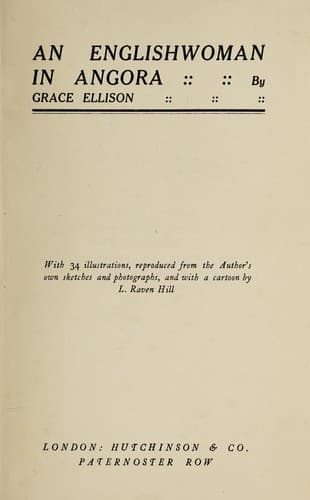
Atatürk, Kemal, 1881-1938; Turkey -- Description and travel; Turkey -- Politics and government -- 1918-1960
Mr. Neville Henderson, the British _chargé d’affaires_ at
Constantinople, though certainly not pro-Turk, does not hesitate to
criticise the Greeks. An ideal sense of balance for a diplomat.
The Turks like Mr. Henderson; and when I remarked on the apparent
anomaly that “one can be popular in Turkey without being pro-Turk,” I
was met by the astounding retort that “he succeeds because he knows how
to talk”—a strong argument against “silent” diplomacy!
I can only hope that he may long remain at his post. Although he may not
like to hear his beloved Foreign Office called a “mausoleum,” or the
burial-ground for twentieth-century ideals. Of him, one can repeat what
a Cabinet Minister once said of France: that “he is one of the few ready
to give a criminal, or a genius, _his chance_.” Though not an enthusiast
for any “Asiatic Revival,” he will accept the inevitable, and cheer the
winner. May he stay at his post _at least_ till danger is past.
* * * * *
I have just made my first, and I hope my last, stay in Pera. The
sister-in-law of my little Turkish sister is dying, so I cannot accept
her hospitality, though she has begged me to come to her.
What a terrible warning one can take from Pera! I had not realised the
danger of losing oneself in the ambition to be truly cosmopolitan. These
people belong to all nations and have the souls of none. Their faces
have only one common feature—the lack of the spirit behind all racial
types, the entire absence of any ideal. In Anatolia I found two forms of
inborn honour: the “nationalist” and the “primitive peasant.” In Pera I
stepped from Tokatlian’s Hotel to the Embassy with the feeling that
someone is going to stab me in the back.
* * * * *
This is the fourth Christmas I have spent in Turkey. On the first
occasion the Germans invited me to their Christmas Tree; outside some
Armenians sang their exquisite native carols; which, like their
folk-songs, make one wish their characters were equally fine. The
concert, however, was interrupted by the master-scavengers of
Constantinople, the innumerable dogs, against whose furious barking the
Christians at first bravely held on. But the “enemy” trotted away to
collect his forces from every quarter of the city and, in the end, I won
a wager for the dogs _versus_ the Christians. Our entertainers went
home, amidst a never-to-be-forgotten chorus of canine howling.
In Constantinople the dogs certainly had their own nationality. Divided
against each other by street feuds, the biggest troop coming from the
“station beat,” where cans of rubbish are emptied from the Orient
express, they yet _united_ to drive out the “alien” Christians from the
fatherland of “Dogdom!”
And so it is with the Moslems. If Albania and Syria have left their
fatherland, it is not wise for a foreigner to utter a word against
Turkey in their presence.
Public-domain text, read in full here on John Shaqi.
Reviews
Reviews
No reviews yet
Be the first to share your thoughts on this work.
Elsewhere in the archive
Join the Discussion
Join the discussion
Sign in to leave a comment or review.
Sign InorCreate an account