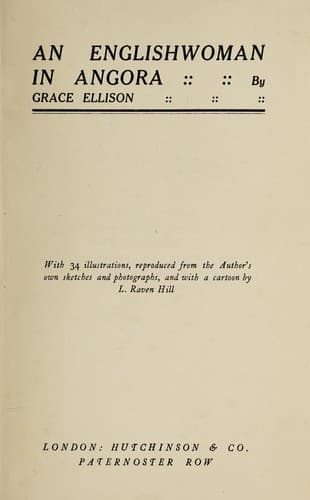
Atatürk, Kemal, 1881-1938; Turkey -- Description and travel; Turkey -- Politics and government -- 1918-1960
LAUSANNE PALACE HOTEL—THE HOME OF TURKEY, FRANCE, AND JAPAN—“EVERY
POSSIBLE PHASE OF COMPLETE INTERNATIONALISM”
“PLEASE reserve comfortable room for Englishwoman coming from Angora,”
so ran the telegram despatched by an American friend of mine, who had
gallantly determined that I should be well looked after. It was both
comfortable and warm; and, to complete the welcome, my waking eyes next
morning are caught by the two flags I have learnt to love so well, the
Turkish and the French—the “standards” of two brave peoples, with the
fine spirit that nothing can subdue, who would choose rather to be
annihilated than to live in servitude.
Then I notice the flag of Japan! “What has Japan to do with it?” I ask
Ismet Pasha.
“Ah, Miss d’Angora,” he answers with a laugh, “it is fine sport to watch
the poor little bird as they pluck out his feathers and clip his wings.”
Indeed, Lausanne has been “revolutionised” by this Conference of Peace!
It is a golden harvest for the hotels, which have not a room unoccupied.
Every day luncheons, dinners, and banquets! Everywhere representatives
of the world’s Press! I feel strange, somehow, in a “neutral” country.
Ever since 1914 I have been living, or travelling, over “seats of war,”
in lands fighting to defend, or attack, an Ideal.
One can respect any sort of an “opinion” from some point of view; but
“neutrality” and “anonymity” do not sound to me like attributes in which
a free and independent people should feel much pride. Yet the
“neutrality” of Switzerland means the _International Red Cross_ and the
_League of Nations_; and it has surely earned by its hospitality to the
world’s statesmen, a right to play _its_ part in the historical peace,
for which “the God who Forgives” is waiting.
The Orient express is bringing the peoples together; Lord Curzon
from London, Ismet Pasha from Angora. May their political discussion
travel under one company to our home of peace! This Hotel of the
Strange Tongues is fast become a very Tower of Babel, for it reveals
every possible phase of complete internationalism, from fox-trots
and cocktails to the folk-songs of Anatolia, sung by the Pasha’s
Guards when off duty. Here, too, are thronging a host of new
nationalities—Georgians, Bolsheviks, Syrians, Sons of Palestine, and
Armenians; each fired by their own ideals, each proud of their
independence; all sighing for the (political) moon.
For the moment, of course, the Conference has resolved itself into a
duel between Lord Curzon and Ismet Pasha. Mme. B., indeed, is indignant
because, she says, “our English representative has so bullied the French
delegate that he has been obliged to take to his bed,” though one can
hardly believe that proud and mighty Republic would choose a man whom
anyone could really bully to bed!
Public-domain text, read in full here on John Shaqi.
Reviews
Reviews
No reviews yet
Be the first to share your thoughts on this work.
Elsewhere in the archive
Join the Discussion
Join the discussion
Sign in to leave a comment or review.
Sign InorCreate an account