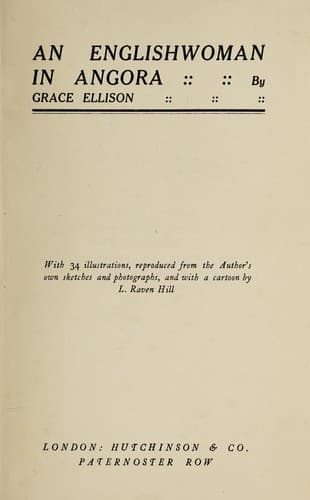
Atatürk, Kemal, 1881-1938; Turkey -- Description and travel; Turkey -- Politics and government -- 1918-1960
And, partly no doubt because they may not comment upon anything of real
importance, the papers are always ready to enlarge upon some trivial
detail that is calculated to fan the flames of hate, or point the finger
of scorn, towards any Turk. Someone asserted that the Turkish military
expert had made a little mistake in preparing a map. He himself did not
admit that he was wrong; but in any case, no one pretended that the
matter was in the least important; and it could, ultimately, be
rectified without the slightest effect on policy. Remember, too, that
the poor man was working from surveys prepared on different systems, and
in a language that describes everything for us backwards. It would not
be remarkable if some slight error _were_ made in transposing the
details to European measures and methods. Yet the papers all give
columns exposing the “little mistake,” which, most probably, was never
made. Vital questions, meanwhile, were almost entirely ignored in the
Press; and the “insolent” Asiatics are filled with bitter resentment. It
is idle for Mr. MacClure to say that “they must expect criticism.” What
they complain of is not “criticism,” but the entire “ignoring” of their
point of view—a very different thing.
The journalist whom I thus attacked admitted that they deserved all I
said. “The public,” he added, “_has_ been misled, one might say
‘cheated.’ I _could_ myself have supplied a good deal of first-class
information, sufficiently dramatic and interesting to ‘raise
circulations’; had I refused my signature to the ‘official’ news so
sparingly doled out for me to put into shape. I can promise you that, on
me at least, your words have not been wasted.”
Let us hope he may substantiate his pledge. At present the Press is
neither a critic, a check on intrigue, nor an inspiration. It echoes the
Governments, good or bad. In Constantinople, for instance, the American
and English “special correspondents” frankly confessed that they employ
a few “scouts” to collect copy, and merely “hash up” what comes in from
these “scavengers” of rumour and gossip.
* * * * *
Propaganda in the Turkish Press is under the direction of Kemal Bey (the
poet) and Ruchène Echref. Men of such literary distinction, alas, are no
better fitted for such work than a watchmaker would be to heave coal. In
Turkey they do not understand how heavy are the hands that can mange
propaganda: that posts are created for the men who can fill them, and
men are not made for any post that may happen to be vacant.
* * * * *
Public-domain text, read in full here on John Shaqi.
Reviews
Reviews
No reviews yet
Be the first to share your thoughts on this work.
Elsewhere in the archive
Join the Discussion
Join the discussion
Sign in to leave a comment or review.
Sign InorCreate an account