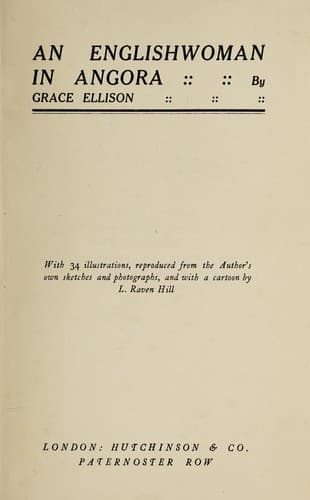
Atatürk, Kemal, 1881-1938; Turkey -- Description and travel; Turkey -- Politics and government -- 1918-1960
On the other hand, one must acknowledge that the Turk’s attitude towards
his detractors is more lofty than practical. Pride forbids him to answer
accusations, or disseminate the truth; which he, as a fatalist, firmly
believes “must out”! They will, certainly, never hoist the propagandist
“on his own petard,” since, to their thinking, the man who accepts money
to defend a cause is no better than a “political prostitute.” They argue
that “he who works for me, must believe in me, as a true friend, eager
to help.” And for the moment, Europe has made them feel that “facts”
would avail them nothing—“whatever we do is wrong.”
In the East news spreads with accurate rapidity without the assistance
of newspapers; but the foreigner who needs chapter and verse for every
statement may be, to some extent, excused for suspecting their obstinate
reticence about statistics and exact figures. I should, myself, have
welcomed more information about a story I quite believe, but cannot
substantiate, that came from an Italian lady at Broussa. She said that
the Greeks burnt a Turkish prison, _with all the prisoners in it_, and,
“to her dying day she would never forget their awful screams,” but no
one will give me the least idea of how many prisoners were slaughtered.
I called on a Vali whose palace was burned to cinders before I had the
information. And I could discover no precise details, despite inquiry at
Angora, Constantinople, and Lausanne!
The Norwegian head of the Minorities Committee, a man given to wise and
just decisions, has said: “It is no use expecting Asiatics to be
Europeans. They have as much right to do things in their Asiatic way, as
we have to act like Europeans. There are standards of right and wrong,
against which neither may transgress, but for the rest, nothing can be
done.” He also agreed that to secure protection from a minority, you
must enforce loyalty to the majority. I told him the head of the
Armenian community had begged the Pope to see that they “were left to
the mercy” of the Turks, which _is_ merciful.
The League can really help Christians in Turkey by putting a stop to
pro-Christian propaganda, for which Armenians in Anatolia will have to
suffer.
There is so much that the League of one’s dream could do for Turkey, as
for all the peoples; and we criticise only from hope and desire of some
hastening in its approach to perfection, and the establishing of its
supreme authority. As Sir Eric Drummond pointed out, the high-handed and
retrograde attitude towards Eastern problems would not be possible were
Turkey represented on the council: as others have seen, that while the
so-called “enemy” peoples are unrepresented, the League cannot be truly
either impartial or international.
To secure equal justice for all, it must stand outside, and above,
divisions of race, creed or prejudice.
Public-domain text, read in full here on John Shaqi.
Reviews
Reviews
No reviews yet
Be the first to share your thoughts on this work.
Elsewhere in the archive
Join the Discussion
Join the discussion
Sign in to leave a comment or review.
Sign InorCreate an account