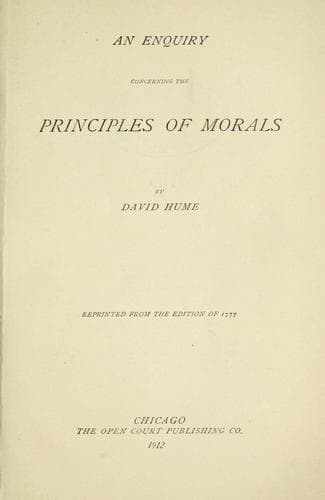
An Enquiry Concerning the Principles of MoralsHume, David
PhilosophyPhilosophy
An Enquiry Concerning the Principles of Morals
Hume, David
Conduct of life; Ethics
pursuits, by which he, at once, ensures his happiness and his honour.
Self-satisfaction, at least in some degree, is an advantage, which
equally attends the fool and the wise man: But it is the only one; nor
is there any other circumstance in the conduct of life, where they are
upon an equal footing. Business, books, conversation; for all of these,
a fool is totally incapacitated, and except condemned by his station
to the coarsest drudgery, remains a useless burthen upon the earth.
Accordingly, it is found, that men are extremely jealous of their
character in this particular; and many instances are seen of profligacy
and treachery, the most avowed and unreserved; none of bearing patiently
the imputation of ignorance and stupidity. Dicaearchus, the Macedonian
general, who, as Polybius tells us [Footnote: Lib. xvi. Cap. 35.],
openly erected one altar to impiety, another to injustice, in order to
bid defiance to mankind; even he, I am well assured, would have started
at the epithet of FOOL, and have meditated revenge for so injurious an
appellation. Except the affection of parents, the strongest and most
indissoluble bond in nature, no connexion has strength sufficient to
support the disgust arising from this character. Love itself, which
can subsist under treachery, ingratitude, malice, and infidelity, is
immediately extinguished by it, when perceived and acknowledged; nor
are deformity and old age more fatal to the dominion of that passion.
So dreadful are the ideas of an utter incapacity for any purpose or
undertaking, and of continued error and misconduct in life!
When it is asked, whether a quick or a slow apprehension be most
valuable? Whether one, that, at first view, penetrates far into a
subject, but can perform nothing upon study; or a contrary character,
which must work out everything by dint of application? Whether a
clear head or a copious invention? Whether a profound genius or a sure
judgement? In short, what character, or peculiar turn of understanding,
is more excellent than another? It is evident, that we can answer
none of these questions, without considering which of those qualities
capacitates a man best for the world, and carries him farthest in any
undertaking.
If refined sense and exalted sense be not so USEFUL as common sense,
their rarity, their novelty, and the nobleness of their objects make
some compensation, and render them the admiration of mankind: As gold,
though less serviceable than iron, acquires from its scarcity a value
which is much superior.
Public-domain text, read in full here on John Shaqi.
Reviews
Reviews
No reviews yet
Be the first to share your thoughts on this work.
Elsewhere in the archive
Join the Discussion
Join the discussion
Sign in to leave a comment or review.
Sign InorCreate an account