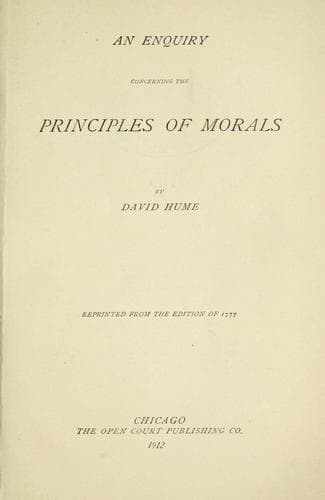
An Enquiry Concerning the Principles of MoralsHume, David
PhilosophyPhilosophy
An Enquiry Concerning the Principles of Morals
Hume, David
Conduct of life; Ethics
It is evident, that one considerable source of BEAUTY in all animals
is the advantage which they reap from the particular structure of their
limbs and members, suitably to the particular manner of life, to which
they are by nature destined. The just proportions of a horse, described
by Xenophon and Virgil, are the same that are received at this day by
our modern jockeys; because the foundation of them is the same, namely,
experience of what is detrimental or useful in the animal.
Broad shoulders, a lank belly, firm joints, taper legs; all these are
beautiful in our species, because signs of force and vigour. Ideas of
utility and its contrary, though they do not entirely determine what is
handsome or deformed, are evidently the source of a considerable part of
approbation or dislike.
In ancient times, bodily strength and dexterity, being of greater USE
and importance in war, was also much more esteemed and valued, than
at present. Not to insist on Homer and the poets, we may observe,
that historians scruple not to mention FORCE OF BODY among the other
accomplishments even of Epaminondas, whom they acknowledge to be the
greatest hero, statesman, and general of all the Greeks. [Footnote: CUM
ALACRIBUS, SALTU; CUMM VELOCIBUS, CURSU; CUM VALIDIS RECTE CERTABATA.
Sallust apud Veget.] A like praise is given to Pompey, one of the
greatest of the Romans. [Footnote: Diodorus Siculus, lib. xv. It may
be improper to give the character of Epaminondas, as drawn by the
historian, in order to show the idea of perfect merit, which prevailed
in those ages. In other illustrious men, say he, you will observe, that
each possessed some one shining quality, which was the foundation of his
fame: In Epaminondas all the VIRTUES are found united; force of body.
eloquence of expression, vigour of mind, contempt of riches, gentleness
of disposition, and what is chiefly to be regarded, courage and conduct
of war.] This instance is similar to what we observed above with regard
to memory.
What derision and contempt, with both sexes, attend IMPOTENCE; while the
unhappy object is regarded as one deprived of so capital a pleasure in
life, and at the same time, as disabled from communicating it to others.
BARRENNESS in women, being also a species of INUTILITY, is a reproach,
but not in the same degree: of which the reason is very obvious,
according to the present theory.
There is no rule in painting or statuary more indispensible than that of
balancing the figures, and placing them with the greatest exactness on
their proper centre of gravity. A figure, which is not justly balanced,
is ugly; because it conveys the disagreeable ideas of fall, harm, and
pain.
Public-domain text, read in full here on John Shaqi.
Reviews
Reviews
No reviews yet
Be the first to share your thoughts on this work.
Elsewhere in the archive
Join the Discussion
Join the discussion
Sign in to leave a comment or review.
Sign InorCreate an account