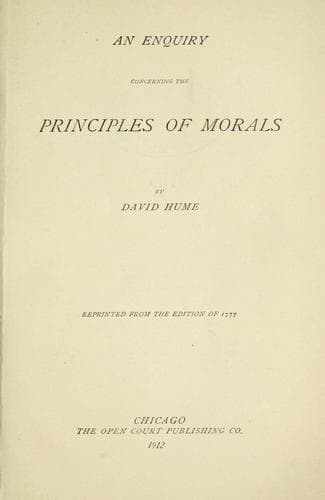
An Enquiry Concerning the Principles of MoralsHume, David
PhilosophyPhilosophy
An Enquiry Concerning the Principles of Morals
Hume, David
Conduct of life; Ethics
But not to go so far as prisoners of war or the dead, to find instances
of this disinterested regard for riches; we may only observe, with
a little attention, those phenomena which occur in common life and
conversation. A man, who is himself, we shall suppose, of a competent
fortune, and of no profession, being introduced to a company of
strangers, naturally treats them with different degrees of respect, as
he is informed of their different fortunes and conditions; though it
is impossible that he can so suddenly propose, and perhaps he would
not accept of, any pecuniary advantage from them. A traveller is always
admitted into company, and meets with civility, in proportion as his
train and equipage speak him a man of great or moderate fortune. In
short, the different ranks of men are, in a great measure, regulated
by riches; and that with regard to superiors as well as inferiors,
strangers as well as acquaintance.
What remains, therefore, but to conclude, that, as riches are desired
for ourselves only as the means of gratifying our appetites, either at
present or in some imaginary future period, they beget esteem in others
merely from their having that influence. This indeed is their very
nature or offence: they have a direct reference to the commodities,
conveniences, and pleasures of life. The bill of a banker, who is broke,
or gold in a desert island, would otherwise be full as valuable. When we
approach a man who is, as we say, at his ease, we are presented with the
pleasing ideas of plenty, satisfaction, cleanliness, warmth; a cheerful
house, elegant furniture, ready service, and whatever is desirable in
meat, drink, or apparel. On the contrary, when a poor man appears,
the disagreeable images of want, penury, hard labour, dirty furniture,
coarse or ragged clothes, nauseous meat and distasteful liquor,
immediately strike our fancy. What else do we mean by saying that one
is rich, the other poor? And as regard or contempt is the natural
consequence of those different situations in life, it is easily seen
what additional light and evidence this throws on our preceding theory,
with regard to all moral distinctions.
Public-domain text, read in full here on John Shaqi.
Reviews
Reviews
No reviews yet
Be the first to share your thoughts on this work.
Elsewhere in the archive
Join the Discussion
Join the discussion
Sign in to leave a comment or review.
Sign InorCreate an account