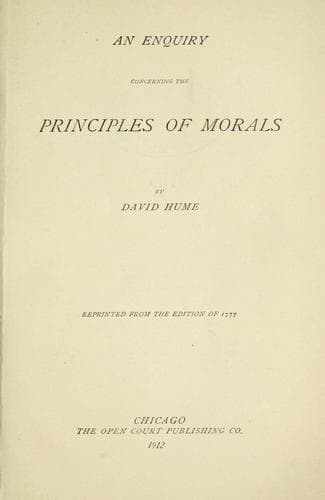
An Enquiry Concerning the Principles of MoralsHume, David
PhilosophyPhilosophy
An Enquiry Concerning the Principles of Morals
Hume, David
Conduct of life; Ethics
IT may justly appear surprising that any man in so late an age, should
find it requisite to prove, by elaborate reasoning, that Personal Merit
consists altogether in the possession of mental qualities, USEFUL or
AGREEABLE to the PERSON HIMSELF or to OTHERS. It might be expected that
this principle would have occurred even to the first rude, unpractised
enquirers concerning morals, and been received from its own evidence,
without any argument or disputation. Whatever is valuable in any kind,
so naturally classes itself under the division of USEFUL or AGREEABLE,
the UTILE or the DULCE, that it is not easy to imagine why we should
ever seek further, or consider the question as a matter of nice research
or inquiry. And as every thing useful or agreeable must possess these
qualities with regard either to the PERSON HIMSELF or to OTHERS, the
complete delineation or description of merit seems to be performed as
naturally as a shadow is cast by the sun, or an image is reflected upon
water. If the ground, on which the shadow is cast, be not broken and
uneven; nor the surface from which the image is reflected, disturbed
and confused; a just figure is immediately presented, without any art
or attention. And it seems a reasonable presumption, that systems and
hypotheses have perverted our natural understanding, when a theory,
so simple and obvious, could so long have escaped the most elaborate
examination.
But however the case may have fared with philosophy, in common life
these principles are still implicitly maintained; nor is any other topic
of praise or blame ever recurred to, when we employ any panegyric or
satire, any applause or censure of human action and behaviour. If we
observe men, in every intercourse of business or pleasure, in every
discourse and conversation, we shall find them nowhere, except the
schools, at any loss upon this subject. What so natural, for instance,
as the following dialogue? You are very happy, we shall suppose one to
say, addressing himself to another, that you have given your daughter
to Cleanthes. He is a man of honour and humanity. Every one, who has
any intercourse with him, is sure of FAIR and KIND treatment. [Footnote:
Qualities useful to others.] I congratulate you too, says another,
on the promising expectations of this son-in-law; whose assiduous
application to the study of the laws, whose quick penetration and early
knowledge both of men and business, prognosticate the greatest honours
and advancement. [Footnote: Qualities useful to the person himself.]
You surprise me, replies a third, when you talk of Cleanthes as a man
of business and application. I met him lately in a circle of the gayest
company, and he was the very life and soul of our conversation: so much
wit with good manners; so much gallantry without affectation; so much
ingenious knowledge so genteelly delivered, I have never before observed
in any one. [Footnote: Qualities immediately agreeable to others,]
Public-domain text, read in full here on John Shaqi.
Reviews
Reviews
No reviews yet
Be the first to share your thoughts on this work.
Elsewhere in the archive
Join the Discussion
Join the discussion
Sign in to leave a comment or review.
Sign InorCreate an account