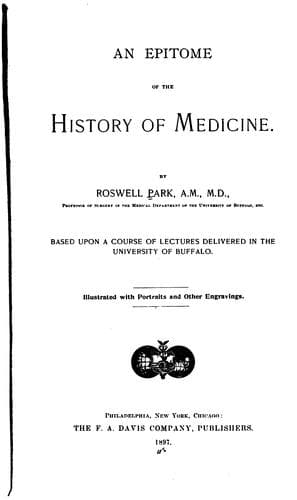
An Epitome of the History of MedicinePark, Roswell
History
An Epitome of the History of Medicine
Park, Roswell
Medicine -- History
And so the errors of science, the prejudices of the superstitious, the
excitement of the religious, and the cupidity of the rich and powerful,
all concurred to propagate the faults of the cabal at the close of the
Middle Ages. Never were there seen so many sorcerers, astrol-ogists,
and alchemists; never were prophecies, visions, and prodigies so common.
Whatever happened, it was pretended{142} that it had been announced
by some previous sign, or that it was a revelation of the future. This
particular kind of folly persisted in Germany longer than in any other
part of the world. Even Martin Luther seemed to share many of the
cabalistic views, and his alleged struggle with the devil, his adventure
with the inkstand, and so on, contributed much to spread them, and were,
perhaps, the most prominent illustrations of their general acceptance.
Surely, these were the Dark Ages.
Jerome Cardan was born at Pavia in 1501. His life, like that of Agrippa,
was one of vicissitude and inconsistency. Being the idol of his mother
and the detestation of his father produced a peculiar effect upon his
character. When he began to study he made rapid progress, and at the
age of twenty-two was able to discuss publicly all questions. About
two years later he received his doctor's hat. He practiced medicine in
various places until he was thirty-three, and was then made professor
of mathematics at Milan. He occupied this position but two years, then
traveled in Germany, France, and England, and returning to Italy was
imprisoned for debt in Bologna, and finally obtained a pension from the
pope, in Rome, where he died in 1556. He was a man of great attainments
and sagacity; his literary style was dignified, and, if he had not
developed such a taste for the marvelous, such inconceivable credulity
and superstition, and such vanity and boasting, he would have been a
remarkable character in his age. Leibnitz said of him: "Notwithstanding
his faults, Cardan was a great man and, without his defects, would have
been incomparable." He wrote extensively on philosophy, mathematics,
and medicine. Sometimes he admitted to his writings the most absurd
statements of visions, etc., and again affirmed that he had never
devoted himself to cabalistic art, blamed those who practiced it, and
jeered at those who believed in it. He wrote extensively on chiromancy.
For his own follies and misfortunes he apologized,{143} attributing them
all to the influences of the stars.
[Illustration: 0163]
Public-domain text, read in full here on John Shaqi.
Reviews
Reviews
No reviews yet
Be the first to share your thoughts on this work.
Elsewhere in the archive
Join the Discussion
Join the discussion
Sign in to leave a comment or review.
Sign InorCreate an account