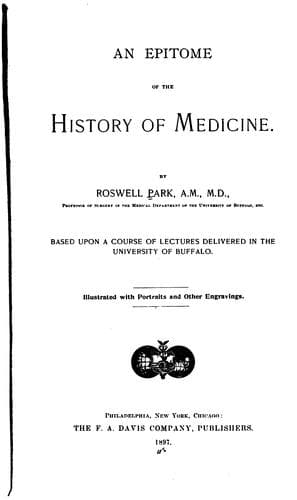
An Epitome of the History of MedicinePark, Roswell
History
An Epitome of the History of Medicine
Park, Roswell
Medicine -- History
It was during this period of which we have written that the separation
of the priesthood from medicine was completed. From the sixteenth
century celibacy was not obligatory on physicians in the Kingdom of
France, and they no longer enjoyed ecclesiastical benefices. At this
time, too, surgery, which had naturally been separated from medicine,
began to approach it, the combination thus gradually brought about
inuring to the benefit of all concerned. From now on, the professors of
St. Come were on the same level as the professors of the university,
and enjoyed equal privileges. Institutions for instruction in medicine
increased, and those which already existed were developed. Amphitheaters
for dissection were open in every city in Europe. Hospitals and
dispensaries were established alongside the schools, and by the various
governments more attention was paid to the protection of the public
from imposition, and to the amelioration of every evil affecting either
public or private health.
CHAPTER VI.
_Age of Renovation (continued).--Student-life During the Fifteenth and
Sixteenth Centuries. Ceremonials Previous to Dissection.--Reform Period:
The Seventeenth, Eighteenth, and Nineteenth Centuries. Modern Realism
in Medicine and Science. Introduction of the Cell-doctrine. Discovery
of the Circulation. William Harvey, 1578-1637. Malpighi, 1628-1694.
Leuwenhoek, 1632-1723. Correct Doctrine of Respiration. Discovery of
the Lymphatic Circulation. The Nervous System. Discovery of Cinchona.
Development in Obstetric Art, in Medical Jurisprudence, in Oral Clinical
Teaching. Van Helmont, 1578-1644.--The Iatrochemical System: Le Bôe,
1614-1672. Thomas Willis, 1622-1675._
For a{148} long time the Italian universities held the first rank; next
came the French; and last the German, although all were well attended.
The most famous were the medical faculties of Bologna, Pisa, Padua; then
Paris, Montpellier, and, finally, Basel.
A little of what concerned the student-life of this period may not be
amiss. The students chose the rector and officers of the universities,
sometimes even the teachers, and assisted in determining the curriculum
of study, the execution of which they watched. In some of the Scotch
universities even now the students choose the rector.
The students were divided, usually according to country, into bodies
denominated "nations" (some having special seals), which were the
parents of the present stu-dent-corps in German universities. Certain
representatives, known as vice-rectors, were chosen from each of these
corps and constituted a so-called college of rectors which negotiated
with the officials of the State, and possessed a power that was
preserved until the end of the sixteenth century.
Public-domain text, read in full here on John Shaqi.
Reviews
Reviews
No reviews yet
Be the first to share your thoughts on this work.
Elsewhere in the archive
Join the Discussion
Join the discussion
Sign in to leave a comment or review.
Sign InorCreate an account