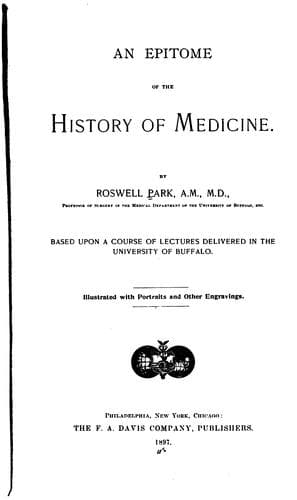
An Epitome of the History of MedicinePark, Roswell
History
An Epitome of the History of Medicine
Park, Roswell
Medicine -- History
The seventeenth century, in contrast to the idealistic sixteenth,
witnessed the advent of modern realism in almost all departments of
thought. Medicine furnished the first example in what we are accustomed
to-day to speak of as the exact method; hence, the century is of great
importance, in that physicists and chemists began to be original,
instead of mere followers of the past. The most notable feature
of medicine was the promulgation of three medical systems: the
pietistically colored Paracelsism of Van Hel-mont; the chemical
system of Sylvius; and the iatro-cliemical system of the physicist and
mechanician, Borelli. This period is, moreover, illumined by the life of
one great practitioner, whose name will be imperishable in the history
of our art,--namely, Sydenham.
The principal tendency of the time was toward skepticism, which had
begun in the preceding century with Montaigne, and was continued by
Charron, under the patronage of Queen Marguerite of Navarre; it was the
fundamental idea of Pierre Bayle, the author of the great dictionary.
Opposed thereto was the supernatural philosophy, or the theosophic,
cabalistic, or mystic. The leading exponent of the latter was Boehme,
who was a business colleague of the celebrated "Meistersinger," Hans
Sachs, in Germany, and of Blaise Pascal and his contemporary.
Malebranche,{153} in France. The doctrine of Lord Bacon, Lord Verulam
(1561-1626), a man who showed himself as exalted in mind as he was
mean in personal traits, was of great importance Bacon is a landmark
in history as the defender and eulogist of modern realism,--i.e., of
inductive philosophy. While personally contributing but little to the
advance of science, he taught a great method; as Gruen says, he was the
philosopher of patents and profit; he recognized the compass, the art of
printing, and gunpowder as great inventions, but placed little value on
the discovery of Copernicus, having little comprehension of mathematics.
Hobbes and Locke went farther into realistic philosophy, and the latter
was an exponent later of pure empiricism.
Public-domain text, read in full here on John Shaqi.
Reviews
Reviews
No reviews yet
Be the first to share your thoughts on this work.
Elsewhere in the archive
Join the Discussion
Join the discussion
Sign in to leave a comment or review.
Sign InorCreate an account