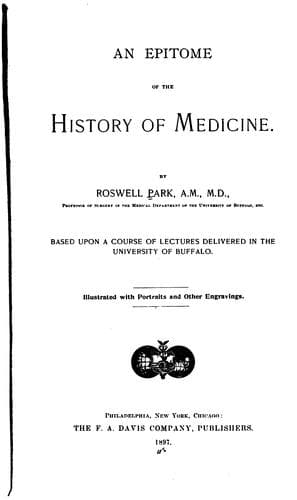
An Epitome of the History of MedicinePark, Roswell
History
An Epitome of the History of Medicine
Park, Roswell
Medicine -- History
of Boerhaave, the school of Leyden rapidly declined, while those of
Edinburgh and Vienna became rivals for the first place. It is thus seen
that after an interruption of more than two thousand years clinical
teaching was revived and became more brilliant than ever before.
I now propose to recount the methods and deeds of some of those
concerned in the development of systems, so called, and make mention of
the most prominent medical men in national and historical order. This
will not prevent going back to philosophical conclusions or reflections
upon the philosophy of the history of medicine, when it may seem wise so
to digress.
First, of the system of J. B. Van Helmont, which in its day was most
highly regarded, and which seems to have been, in some measure, a
rearrangement of the views of Paracelsus into a mystic and pietistic
system based upon mechanical principles. Van Helmont was born in
Brussels in 1578, and was so precocious that he entered the University
of Louvain at an age which would have enabled him, had he so desired, to
obtain the degree of Magister when only seventeen years old, he deemed
the degree frivolous. He had studied mathematics, astronomy, philosophy,
and astrology. Going now to the Jesuits, who at that time, even, taught
music, he soon became dissatisfied, and turned to the study of stoical
philosophy. Believing that the{169} Capuchins (who were mere lascivious
gluttons, and considered even washing unchristian) were the true stoics,
he sought to join this order, but ere long abandoned them and resumed
his studies in law, botany, and medicine. For the latter Van Helmont had
at first little respect, since his studies in this line did not enable
him to rid himself of the itch. He soon again lapsed to the monastics,
and came to the conclusion that wisdom, like the grace of God, was
obtainable only by fasting, supplication, and poverty; accordingly he
practiced medicine among the poor as a labor of love (having received
his degree of Doctor in 1599). During his travels he became familiar
with the writings of Paracelsus, which he studied zealously. Finally
he settled down in Vilvorde, where he practiced medicine and chemistry
until his death (in 164-4).
Like most "systems," that of Van Helmont is valued only as an expression
of the spirit of the age, since it embodied largely the pantheism of
Paracelsus, merely cloaked with a more religious or monkish dress. He
held that the general cause of disease was the fall of man; though
there also figured a subsidiary cause, which he denominated Archeus,--a
faculty of appetite seated in the spleen or in the stomach; thus dropsy
was a hindrance of renal excretion by the enraged Archeus. Demons,
witches, and ghosts were included in Van Helmont's system as causes of
disease. Indeed, the man seems to have been a second Paracelsus, lacking
only in the dishonesty and bombast of the latter. He had no followers of
any prominence, and the "system" soon lapsed into obscurity.
Public-domain text, read in full here on John Shaqi.
Reviews
Reviews
No reviews yet
Be the first to share your thoughts on this work.
Elsewhere in the archive
Join the Discussion
Join the discussion
Sign in to leave a comment or review.
Sign InorCreate an account