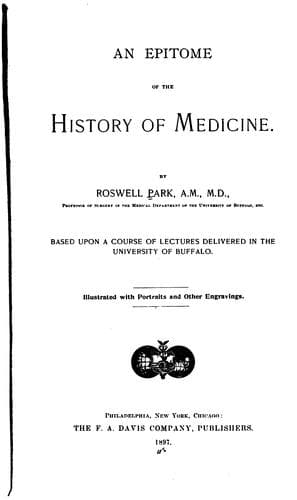
An Epitome of the History of MedicinePark, Roswell
History
An Epitome of the History of Medicine
Park, Roswell
Medicine -- History
By the way, it is an interesting fact that the clinical histories of
many operations for stone during the seventeenth century were related
in verse, and illustrated with plates. Harvey's vivisections were also
related in verse.
Now, for the first time, do we begin to hear of English surgeons and
English surgery. The most prominent, as well as almost the earliest,
was Richard Wiseman (1595-1686), ordinary surgeon of James I, called
sometimes the "Pride of England" and sometimes the "Paré of England,"--a
bold, judicious operator, who took hold of every novelty and who
accepted the ligature of Paré (always having the actual cautery at
hand, in case the ligature should fail); he also amputated through sound
parts,{182} favored operating for strangulated hernia, and employed
the trephine zealously. The first recorded operation for external
urethrotomy for the relief of stricture is mentioned in Wiseman's
writings.
[Illustration: 0201]
There were also William Cowper (1666-1709), a famous anatomist and
surgeon; and Woolhouse, a famous, but ignorant, itinerant oculist. Sir
Christopher Wren, architect of St. Paul's, was the first who devoted
attention to injecting medicine into the veins,--a subject studied again
much later and recently once more taken up. His example (in 1667) was
followed by others, whose experiments demonstrated, as we know to-day,
that the effects which follow the intravenous administration of drugs
are the same as follow administration by the mouth.
Midwifery during the seventeenth century advanced even more rapidly than
its mother-science surgery. The accouchement of women was intrusted in
many cases to the care of educated men, who contributed not a little
to the art. Anatomy and physiology contributed also their quota to a
clearer knowledge of these diseases. The obstetric forceps were for so
long a time kept secret that they were of small benefit at first to
the obstetric art. Among the French who were especially prominent as
promoters of midwifery must be mentioned Marguerite de la Marche, chief
midwife of the Hôtel-Dieu; Francois Mauriceau, President of the College
of St. Come; Jules Clement Delamotte, who was also a skillful surgeon;
and Portal, who first proposed version by one foot Among the Germans a
few midwives distinguished themselves as independent observers, most of
all Justine Siegemundin, daughter of a minister, who devoted herself
to midwifery with such success that she became court midwife; she
recommended puncture of the membranes for the production of artificial
delivery, and especially advocated bimanual version.
Public-domain text, read in full here on John Shaqi.
Reviews
Reviews
No reviews yet
Be the first to share your thoughts on this work.
Elsewhere in the archive
Join the Discussion
Join the discussion
Sign in to leave a comment or review.
Sign InorCreate an account