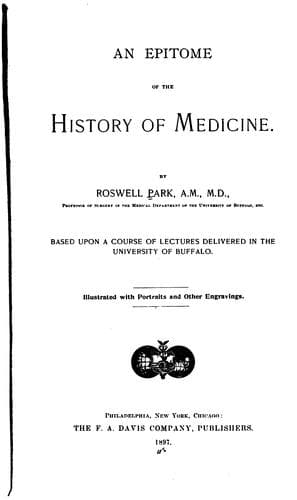
An Epitome of the History of MedicinePark, Roswell
History
An Epitome of the History of Medicine
Park, Roswell
Medicine -- History
"animal magnetism," and was the author of the term "hypnotism," though
in his day the popular title was _Braidism_.
[Illustration: 0225]
During the middle of the eighteenth century arose a doctrine that, in
its novelty, ease of practical application, and apparent consistency
(through the ingenious employment of certain vital phenomena), secured
such a hold that its influence continued even into the present century.
This was{205} the "Brunonian doctrine," promulgated and upheld by
the great foe and rival of Cullen,--Doctor John Brown. In youth very
precocious, though of most humble birth, Doctor Brown had mastered the
Latin language at the early age of seven years, and three years later
essayed to learn a trade. At the age of twenty he left his native
village of Dunse for Edinburgh, seeking employment as a tutor and
intending to study theology. Poverty soon compelled him, however, to
take a rural school, but he returned a few years later (in 1759) to
the Scottish Athens and began the study of medicine, supporting himself
meantime by rendering theses into Latin and by teaching, translating,
and quizzing. Finally, he attracted the attention of Cullen, to whom he
became useful through his knowledge of the classics; but, ultimately, a
foolish quarrel made bitter enemies of the former friends. In 1770, in
private lectures, Brown{206} began to advance the theory to which he had
been led by one of his own attacks of gout that disappeared under the
use of stimulants, the disease having previously always been aggravated
by the treatment prescribed and that was held to be orthodox,--viz.,
antiphlogistic. He had now become somewhat dissolute, and the students
he gathered about him were of very much the same character; but they
formed the nidus of a great following opposed to Cullen, and quarreled
on all occasions with the adherents of the latter. Finally, Doctor Brown
removed to London, where fortune seemed to smile upon him, as he gained
rapidly in reputation and practice; indeed, he barely missed a call to
Berlin and another to Padua as a teacher, the scale being turned against
him by his dissolute habits. Though possessed of the highest mental
gifts, Brown was unfortunate in lack of mental stamina. He taught that
life is not a natural condition, but an artificial and necessary result
of constant irritations; all living beings, therefore, tend toward
death. Health is an intermediate grade of excitement; diseases, which
are either sthenic or asthenic, represent either too high or too low a
grade of excitement. It has been said that Brown's teachings slaughtered
more human beings than the French Révolution and the wars of Napoleon
combined. In England this system found no important followers, but
in America Benjamin Rush, of Philadelphia (1745-1815), distinguished
himself as an adherent. In Spain and France it found little place; but
in Italy, and later in Germany, it secured a numerous and important
Public-domain text, read in full here on John Shaqi.
Reviews
Reviews
No reviews yet
Be the first to share your thoughts on this work.
Elsewhere in the archive
Join the Discussion
Join the discussion
Sign in to leave a comment or review.
Sign InorCreate an account