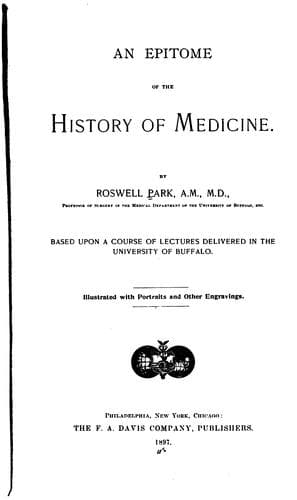
An Epitome of the History of MedicinePark, Roswell
History
An Epitome of the History of Medicine
Park, Roswell
Medicine -- History
The researches of anatomists during the eighteenth century were, for the
most part, directed toward the minute, more difficult, and less striking
parts, and to increased thoroughness and accuracy of description.
Microscopical anatomy suffered a relative quiescence. Pathological and
general anatomy, which were destined to control the medicine of the
succeeding century, were newly created and not yet regarded as sciences
by themselves, but merely as special branches. The most important
feature was the revival and more accurate study of experimental
physiology, which had been scarcely resorted to since the time of Galen,
except for Harvey's discoveries. This revival, which really seemed
an epoch in the history of medicine, was effected by the great Haller
(1708-1777), of Berne,--a man who really deserved the title of "Great,"
as he was a universal and indefatigable _savant_, possessed of thorough
conscientiousness, marvelous capacity for work, great ingenuity, natural
endowments, and an inextinguishable love for art and science; he was
certainly one of the most versatile scholars and thinkers of any
time, distinguished not only in his chosen field of medicine, but as
a poet,{221} botanist, and statesman. Like all Swiss poets, he never
passed beyond the didactic and the homely in his versification. From his
tenth year he wrote poems in Latin and German, and even when eight years
old had made most extensive compilations from Bayle's dictionary. At
fifteen he went to the University of Tubingen, where, in the second year
of his sojourn, he disputed with one of his teachers. In 1725 he went
to Leyden, where Boerhaave and Albinus found in him a most indefatigable
follower. At nineteen he received the degree of doctor. In the excess of
his zeal for anatomy he purchased for a considerable sum, from Albinus,
half of a corpse, the other half of which his teacher had dissected;
and, while in Paris, he even engaged in grave-robbing, and, being
betrayed by his own carelessness, was compelled to save himself by
flight. In many other States, and in more than one country, he studied
with the best of teachers, lecturing at times himself. At the age of
twenty-six he became professor and hospital director at Berne, and in
1752 published his famous researches on irritability. Three years
later he accepted a call to Gottingen as Professor of Anatomy, Surgery,
Chemistry, and Botany. He was the founder of a botanical garden; for
many years was so busy that he slept and lived in his library; and, in
spite of his enormous and unique correspondence with the _savants_
of the world, he never left a letter unanswered. Strange to say, his
permanent influence upon the practice of medicine was only indirect;
and, although he was professor of surgery, and performed many
vivisections, he was never able to persuade himself to perform a
single surgical operation upon the living human being. He it was that
introduced into Germany the use of the watch in counting the pulse. Like
Public-domain text, read in full here on John Shaqi.
Reviews
Reviews
No reviews yet
Be the first to share your thoughts on this work.
Elsewhere in the archive
Join the Discussion
Join the discussion
Sign in to leave a comment or review.
Sign InorCreate an account