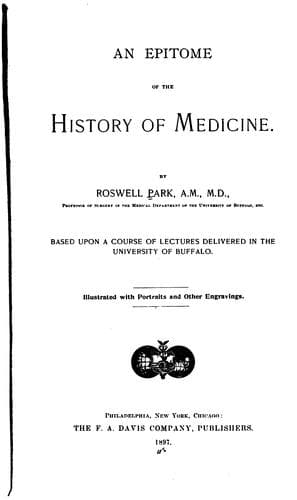
An Epitome of the History of MedicinePark, Roswell
History
An Epitome of the History of Medicine
Park, Roswell
Medicine -- History
Another matter in which the eighteenth century witnessed great reform
was the _treatment of the insane_, which continued in very bad condition
until toward the close of the century, when a movement for improvement
began. From and after this lunatics were liberated from their fetters
and from the hands of brutal keepers, and regarded as actually ill,
while so-called schools of psychiatry were founded. While the first
impulse in this direction was given by Lorry, the true reformer was
Pinel, already mentioned, who did away with corporeal punishment and
abuse, separated the insane from convicts, limited the employment of
drugs and especially venesection, placed the unfortunates in special
institutions under the charge of physicians, and classified patients
according to their symptoms. Yet, in spite of his humane teachings,
lunatics were found incarcerated in cages in some of the French cities
as late as 1834. Pinel was followed by Esquirol (1772-1840), who in 1818
established the first clinic for mental diseases.
It is well known what a conspicuous part _public baths_ played in the
social life of the ancient Greeks and Romans, but{229} the first
public resort for sea-bathing was established in Germany in 1794. The
cold-water epoch of this century, however, began with the researches
of Hahn (16961773), a Silesian, who introduced a systematic and almost
exclusive hydrotherapeutic method. The modern method of using cold
water as an antipyretic agent was first employed in England, in 1797,
by Currie, who originally was an American merchant. In France the method
found little sympathy, but it made its way even to Spain later, where it
was adopted by the famous Sangrado, who is well known to readers of _Gil
Blas_.
CHAPTER IX.
_The Age of Renovation (continued).--The Eighteenth Century; General
Considerations. Foundation of Learned Societies, etc. The Royal College
of Surgeons, 1800; the Josephinum, 1785.--The Nineteenth Century.
Realistic Reaction Against Previous Idealism. Influence of Comte, of
Claude Bernard, and of Charles Darwin, 1809-1882. Influence Exerted by
Other Sciences.--Theory of Excitement: Roeschlaub.--Stimolo and
Contrast imolo: Rasori, 1762-1837.--Homoeopathy: Hahnemann,
1753-1843.--Isop-athy, Electrohomoeopathy of Mattei.--Cranioscopy, or
Phrenology: Gall and Spurzheim.--The Physiological Theory: Broussais,
1772-1838.--Paris Pathological School: Cruveilhier, 1791-1873. Andral,
1797-1876. Louis, 17871872. Magendie, 1783-1855. Trousseau, 1801-1866.
Claude Bernard, 1813-1878.--British Medicine: Bell and Hall, Travers,
1783-1858.--Germany, School of Natural Philosophy: Johannes Müller,
1801-1858.--School of Natural History: Schônlein, 1763-1874.--New Vienna
School: Rokitansky, 1804-1878. Skoda, 1805-1881._
Public-domain text, read in full here on John Shaqi.
Reviews
Reviews
No reviews yet
Be the first to share your thoughts on this work.
Elsewhere in the archive
Join the Discussion
Join the discussion
Sign in to leave a comment or review.
Sign InorCreate an account