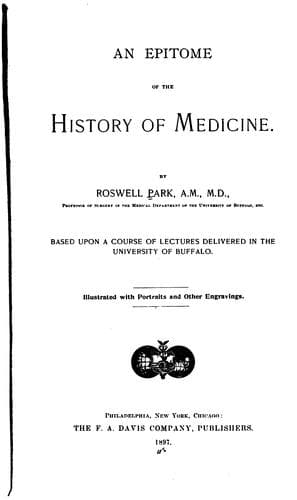
An Epitome of the History of MedicinePark, Roswell
History
An Epitome of the History of Medicine
Park, Roswell
Medicine -- History
Discoveries in botany, the result of better knowledge of natural history
and more accurate habits of study, have influenced{238} modern progress
not a little; have led to better classification and broader knowledge.
The natural system of de Candolle (1778-1841) of Geneva, and of
Endlicher, of Vienna, called into existence the so-called natural
historical school of medicine; the researches into plant-cells by
Schleiden and Baumgartner, and the almost contemporaneous discovery of
animal cells by Schwann became, in course of time, the origin of recent
cellular pathology; then came microscopic botany, and the influence of
the lower fungi in the production of fermentation and putrefaction.
Similarly too, the laws of physics have been shown to have an
inseparable connection with anatomy and physiology, and their study has
become a most important aid in the experimental researches of
to-day; through Helmholz they brought in the ophthalmoscope; thermal
electricity, for the discovery of which medicine is indebted to Seebeck;
a better knowledge of optics, thanks to Fraunhofer, who was equally
expert in electricity; spectrum analysis, invented by Kirchhoff; and
the varied efforts of Faraday, Graham Bell, Thomas Alva Edison, and
Daguerre, the latter better known for his invention of photography.
Finally, medicine is immeasurably indebted to Tyndall and Huxley for
their teaching of the correlation and conservation of energy.
Chemistry also has performed its share, and, as applied to physiology,
is a discovery almost wholly within the present century. The new
nomenclature serves a practical purpose in that it is now possible to
portray chemical combinations and isomerism in a graphic, and at least,
semi-comprehensive way. Among the chemists may be specially mentioned
Bertholet, whose laws are as well known as they are succinct; Humboldt;
Berzelius; Dumas; Chevreuil, who recently died at the age of almost one
hundred years; Magendie; Orfila, the toxicologist; Gmelin, eminent
in physiological chemistry; Rose, perfecter of organic analysis;
Wohler,{239} who first made organic alkaloids; Bunsen; Sir Humphry Davy;
Marsh; Faraday; Graham; Young, who first showed the industrial value of
coal; and Gay-Lussac.
Upon medicine, zoology also, with comparative anatomy and physiology,
has had a wonderful influence; here may be noted the names of Cuvier,
Oken, Bilharz, Brehm, Wagner, Leuckart, Richard Owen, William Carpenter,
and last, but by no means least, Thomas Huxley.
Public-domain text, read in full here on John Shaqi.
Reviews
Reviews
No reviews yet
Be the first to share your thoughts on this work.
Elsewhere in the archive
Join the Discussion
Join the discussion
Sign in to leave a comment or review.
Sign InorCreate an account