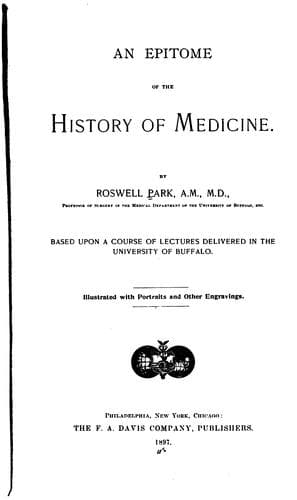
An Epitome of the History of MedicinePark, Roswell
History
An Epitome of the History of Medicine
Park, Roswell
Medicine -- History
The Physiological Theory of Medicine was originated by Broussais
(1772-1838), and combined the views of Pinel and Bichat with the
"sympathetic" view of Hoffmann, the "concealed inflammation" of Stoll,
and the theory of inflammation held by Marcus. Broussais had been a
pupil of Bichat. In 1814 he began hospital teaching, and in 1831 was
made professor. Personally very vain, quick-tempered, even belligerent,
as a therapeutist he was a man of routine. He was, perhaps, best known
shortly before his death, when delivering lectures on phrenology.
According to him, life depends upon external irritation, produced
by heat, which excites new chemical processes, while these in turn
stimulate regeneration, assimilation, as well as contractility, and
sensibility. When the functions supported by heat cease, death ensues.
Health depends upon moderate action of external irritants; disease, upon
either their weakness or their extraordinary strength. He saw nothing
ontological about disease. In therapeutics he admitted the healing power
of Nature, but regarded the physician not as a minister, but as a lord
of Nature. Febrile and inflammatory diseases were all treated by the
withdrawal of nourishment, carried to the extreme. His most powerful
antiphlogistic treatment consisted in the application of leeches to the
abdomen,{244} and to robust individuals he applied from thirty to fifty
at once It is not, then, to be wondered at that, in consequence of his
so-called "hirudinomania," leeches became very scarce In the year 1833
forty-one million five hundred thousand leeches were imported into
France, while in 1824 one-twentieth of this number sufficed to supply
the demand. Even in cases of worms, the abdominal integument had to pay
its blood-tribute, particularly if enteritis prevailed. He only allowed
a spare diet of mucilaginous and acid drinks. In mercurial France and
Italy he gained numerous followers, but they were few and far between
in practical, hard-headed Germany and England. His best follower was
Bouillaud (1797-1881), who adopted the symptomatic nature of fever and
the sanguinary therapeutics of his master, but used the lancet more than
the leech. As the homoeopaths regard Hahnemann, so Bouillaud looked up
to Broussais as the Messiah of medicine and science, which, as Baas says
were "already greatly overstocked with Messiahs."
Public-domain text, read in full here on John Shaqi.
Reviews
Reviews
No reviews yet
Be the first to share your thoughts on this work.
Elsewhere in the archive
Join the Discussion
Join the discussion
Sign in to leave a comment or review.
Sign InorCreate an account