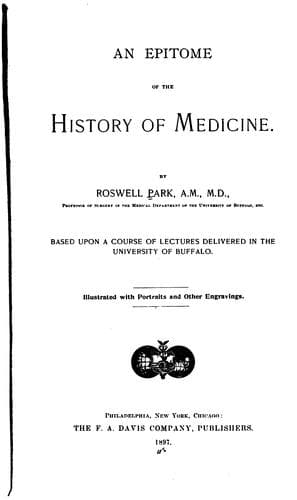
An Epitome of the History of MedicinePark, Roswell
History
An Epitome of the History of Medicine
Park, Roswell
Medicine -- History
Claude Bernard (1813-1878) became the successor of Magendie, and even
more famous as an experimenter in pathology, physiology, and anatomy.
Originally a poet, he finally turned to medicine and science, and in
1869 became a member of the French Academy.
One of the results of the French fondness for pathological anatomy was
an outgrowth, unfortunate in some respects, of specialism, which made
its appearance early and spread to other countries, particularly to
Germany, so that to-day there is scarcely an organ in the body which
has not only its special student, but its special representative in
medicine. It would be of interest to go over some of the various organs
and count those who have become most renowned in the study of their
diseases, but that is beyond the scope of this volume.
As Baas says, England, after her excessive participation in the
iatrochemistrv and iatromechanics of the seventeenth century, with a
devotion that extended far into the eighteenth, seemed then to lose all
confidence in systems and schools of medicine, inasmuch as since that
time no system or so-called school has gained in Great Britain any large
or permanent band of followers; even Brunonianism did not succeed in
this respect. This form of conservatism is a characteristic of the
British race. But while schools have not risen, individuals have
formulated hypotheses or doctrines that at least attracted attention, if
not followers. For instance, John Mason Goode (1764-1827) formulated an
intricate nosological arrangement in his long-popular text-book entitled
_The Study of Medicine_, and{248} also arranged a classification of
diseases now almost forgotten.
In 1816 Sir Charles Bell (1774-1842) made the memorable discovery that
the posterior roots of the spinal nerves preside over sensation, and the
anterior over motion; and this attracted anew the attention of English
physicians to the nervous system, and was rewarded by the later
discovery of reflex action or reflex phenomena, communicated to the
Royal Society in 1863 by Marshall Hall. Both discoveries were important,
and both were duly rewarded by yet others.
Benjamin Travers (1783-1858) seems to have been greatly influenced by
the first of these discoveries, and led thereby to pay special attention
to what he termed "constitutional irritation"; his studies on this
subject are often quoted to-day, and are well worthy of perusal; he
understood by this term a process (in strong contrast with inflammation)
which subsides without hyperæmia and without plastic exudate, but which,
on the other hand, may occasion liquid products and result in neoplasms.
Public-domain text, read in full here on John Shaqi.
Reviews
Reviews
No reviews yet
Be the first to share your thoughts on this work.
Elsewhere in the archive
Join the Discussion
Join the discussion
Sign in to leave a comment or review.
Sign InorCreate an account