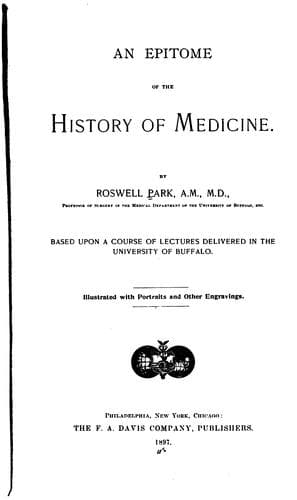
An Epitome of the History of MedicinePark, Roswell
History
An Epitome of the History of Medicine
Park, Roswell
Medicine -- History
As a successor to the School of Natural Philosophy came the School
of Natural History (1831-1850). which made important concessions to
realism; its most prominent members were from South Germany. This school
was based{250} partially upon the philosophy of Nature, and expired
almost suddenly. One of its most eminent exponents was Krukenberg,
whose therapeutic creed was that "Physicians should be filled with
pious reverence toward Nature; the organism is a whole, and must be
contemplated in this sense; medical art is, undoubtedly, capable of
decisive action, but let us not mistake that in many cases its activity
is quite superfluous, in very many null and inadequate, and in many
injurious." This school was the expression of the turn medicine was
compelled to take in order to escape the after-effects of the one-sided,
ideal, systematizing tendency of the eighteenth century (whose final
outcome was natural philosophy), and to square itself with the realism
and positivism of the nineteenth.
Schonlein (1763-1874), of Bamberg, outlined a system that taught
pathological and anatomical revelations as concrete expressions of the
independent entity disease, whose relation to the organism is as that
of a parasite sojourning temporarily in it; he also constructed a
classification of diseases, something after the manner of the botanical
classification of de Candolle. One of his best-known pupils was Canstadt
(1807-1850), whose _Jahresbericht_ has preserved his name. Siebert,
of Jena, famous as a diagnostician, and Haeser, the medical historian,
belonged to this school.
Public-domain text, read in full here on John Shaqi.
Reviews
Reviews
No reviews yet
Be the first to share your thoughts on this work.
Elsewhere in the archive
Join the Discussion
Join the discussion
Sign in to leave a comment or review.
Sign InorCreate an account