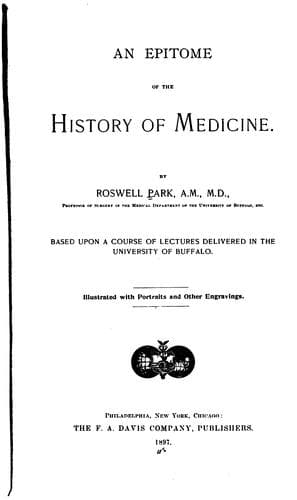
An Epitome of the History of MedicinePark, Roswell
History
An Epitome of the History of Medicine
Park, Roswell
Medicine -- History
The most recent theories of disease are the result of microscopical
study of germs,--the germ-theory, in fact,--and{260} stand in the
closest possible relation with the doctrine of spontaneous generation,
fermentation, miasm, and contagion. In 1838 Ehrenberg regarded infusoria
as animals, but Dujardin in 1841 expressed doubts, and Perty in 1852
affirmed that most forms classified as infusoria should be assigned to
the vegetable kingdom, where, a little later, Naegeli relegated
them. The correctness of this conclusion was proved by Cohn, who also
perfected a classification. This particular form of investigation began
in the twenties of the present century and assumed its present direction
in the thirties and forties. Gaspard, in 1823, renewed the experiments
of Haller, and injected into the veins of animals, not alone putrescent
material, but the blood of other creatures suffering from the effect
of such injections. Bassi, in 1835, discovered the cause of silk-worm
disease, thereby giving special impulse to the theory of parasitism, and
this was quickly followed by evidence of the existence of both vegetable
and animal exciters of disease. Schoenlein, in 1839, demonstrated the
fungus of favus; Vogel discovered the Oïdium albicans in 1840; Goodsir,
the _Sarcina ventriculi_, in 1841; but the greatest influence upon
the development of the parasitic, or germ-theory was the sequel to the
discovery of the anthrax bacillus, by Davaine in 1850. In 1837 Latour
and Schwann demonstrated that the cells, which were known even to
Leeuwenhoeck, were actually vegetable forms, and Schulze had already
pointed out that fermentation of fluids could only occur in the presence
of extremely minute vegetable organisms; Chevreuil next showed that
animal solids remained free from decomposition when protected from the
access of germs; and in 1857 Pasteur demonstrated that fermentation and
putrefaction were caused, not by chemical forms, as Liebig had taught,
but simply by the agency of lower organisms, which he divided into
aerobes and anaerobes; while in 1868 Chauveau queried as to whether
morbific elements resided in the formed elements of germs or in their
fluid{261} constituents. Thus the theory of _contagium vivum_, for which
Henle contended as early as 1821, was not forgotten. In Germany Klebs
and Hueter became the prominent champions of this theory; Hallier had
designated his so-called "Microsporon septicum," and introduced a method
of fractional cultures. The views of Klebs were opposed by Billroth, who
contended for his "phlogistic ferment" and "_Coccobacteria septica_,"
upon which he wrote an elaborate and extensively illustrated treatise;
he also at that time opposed the specific character of the lower
organisms as disease agents. Hallier's _microsporon_ was refuted by
Cohn, who studied and classified the various fungi, and distinguished
between the pathogenic and the septicogenic,--that is, those which
Public-domain text, read in full here on John Shaqi.
Reviews
Reviews
No reviews yet
Be the first to share your thoughts on this work.
Elsewhere in the archive
Join the Discussion
Join the discussion
Sign in to leave a comment or review.
Sign InorCreate an account