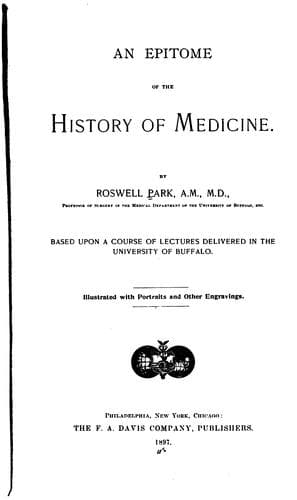
An Epitome of the History of MedicinePark, Roswell
History
An Epitome of the History of Medicine
Park, Roswell
Medicine -- History
Sir Benjamin Brodie (1783-1862) was distinguished as a special
investigator and a soft-tissue operator, of whom it is said that,
basing his actions upon his statistics, the older he became, the less
frequently he operated. His bestknown writings concern diseases of the
joints. Guthrie (1785-1856), a man of noble characteristics, was the
friend and{274} companion of Wellington, whom he accompanied in all his
campaigns. Although well known as a lithotomist, his fame rests chiefly
upon studies and writings in the domain of military surgery. A colleague
of his in the Westminster Hospital, Sir William Lawrence (1783-1867),
was surgeon to the queen, highly esteemed as a dextrous operator, and an
authority on ruptures and on operative surgery. John Lizars (1783-1861)
was a pupil of John Bell, and distinguished himself as a bold operator
and fertile writer; early in the century he treated chronic
hydrocephalus by operation. Robert Liston (1794-1847) was another
remarkable surgeon and a wonderful operator. Sir Charles Bell
(1774-1842) has already been mentioned for his researches on the nerves,
and he also wrote on operative surgery, and is somewhat famed for his
opposition to venesection.
In Edinburgh James Syme (1799-1870) secured great reputation both by
his dexterity as an operator--which is spoken of by his own pupils as
marvelous--and by his introduction of resection into general practice.
Sir James Y. Simpson (1811-1870) aided to make the Edinburgh school
famous by his researches into the domain of both surgery and obstetrics.
Though the inventor of acupressure, his name will forever be associated
with the introduction of chloroform. Professor Dunn says that, u after
seeing the terrible agony of a poor Highland woman under amputation of
the breast, Simpson left the class-room and went straight to Parliament
House to seek work as a solicitor's clerk. But on second thought he
returned to the study of medicine, asking: 'Can anything be done to
make operations less painful?' The ultimate result was the discovery
of chloroform, and so the suffering of one became the occasion of the
deliverance of many. Upon his advocacy of chloroform in obstetrics he
had to defend himself against most vehement attacks of both Scotch and
English clergymen, who affected to regard such procedure as a crime that
transgressed the will of the Deity; but he successfully confounded{275}
these assailants with their own weapons, proving himself their more than
equal in knowledge of Scripture lore.
Public-domain text, read in full here on John Shaqi.
Reviews
Reviews
No reviews yet
Be the first to share your thoughts on this work.
Elsewhere in the archive
Join the Discussion
Join the discussion
Sign in to leave a comment or review.
Sign InorCreate an account