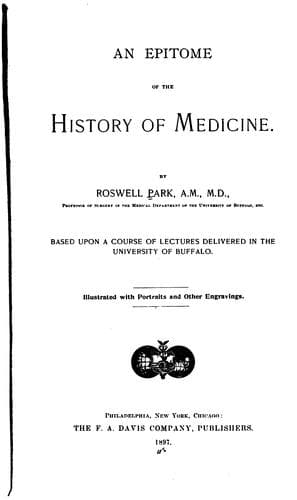
An Epitome of the History of MedicinePark, Roswell
History
An Epitome of the History of Medicine
Park, Roswell
Medicine -- History
In 1789 the profession of Maryland organized the so-called Medical
and Chirurgical Faculty of Maryland, constituting thereby the same
organization as the societies of other States. Before the close of the
century, Delaware, New Hampshire, and South Carolina had also
organized societies. In the larger cities extensive hospitals were also
founded,--the Pennsylvania Hospital, in Philadelphia, in 1751, inside
of which the first clinical instruction in this country was given by Dr.
Thomas Bond. The New York Hospital began in 1769, simultaneously with
the organization of the Medical Department of King's College. The first
insane-asylum in America was built at Williamsburgh, Va., in 1773,
although the charter of the Pennsylvania Hospital, dated 1751, provided
for the care of lunatics, though not at that time in a separate
institution.
[Illustration: 0304]
The most conspicuous medical character of the century in American
history was undoubtedly Benjamin Rush (1745-1813). He was one of
Shippen's earliest students in anatomy, studied widely abroad, was
a member of the Continental Congress, and one of the signers of the
Declaration of Independence. After him is named Rush Medical College of
Chicago. He was an extensive writer on a variety of subjects, not only
professional, but political, philosophical, etc. He recognized but two
kinds of remedies,--stimulants and depressants,--and held it to be
the principal duty of the physician to decide as to which were most
advisable in a given case. He called calomel the "Samson"{284} of the
materia medica, and his opponents contended that he was right, since it
had undoubtedly slain its thousands. As an accurate observer of disease,
he was correct and exact, and his descriptions are to-day both classic
and reliable.
The study of practical anatomy lias always been carried on in this
country under great disadvantages. At first only the bodies of executed
criminals were sparingly furnished.
In 1788, in New York, occurred the celebrated "doctor's mob," which
attested the vehemence of public objection to dissection, and which for
two days defied the control of all the authorities. Secret dissections
had been practiced in Harvard College so early as 1771, but the practice
was against the law even for sixty years later in Massachusetts.
Physiology, as such, was not taught in any medical school in this
country during the century, and experimental{285} physiology was
practically unknown. Surgery was eagerly studied, especially during war
times, and Dr. John Jones (1729-1791), of the King's College School,
was, perhaps, the most eminent of the surgeons of his day. Others who
vied with him were William Shippen, Jr., the first teacher of surgery in
the College of Philadelphia; John Warren, of Boston; Richard Bayley, of
Connecticut; Baynham, of Virginia; and McKnight, of New York.
Public-domain text, read in full here on John Shaqi.
Reviews
Reviews
No reviews yet
Be the first to share your thoughts on this work.
Elsewhere in the archive
Join the Discussion
Join the discussion
Sign in to leave a comment or review.
Sign InorCreate an account