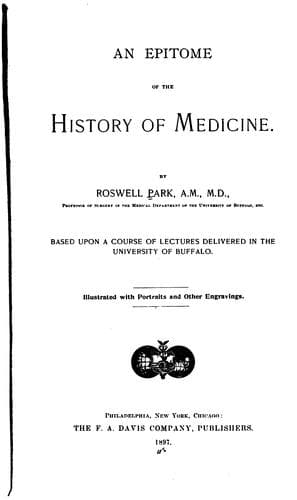
An Epitome of the History of MedicinePark, Roswell
History
An Epitome of the History of Medicine
Park, Roswell
Medicine -- History
In{312} the Public Garden in Boston there has been erected a monument
to the memory of the discoverer of ether, the donor being, at the time,
unable to mention the individual to whom it should be dedicated. Upon
one face is this inscription:--
"_To commemorate the discovery that the inhaling of ether causes
insensibility to pain, first proven to the world at the Massachusetts
General Hospital, in Boston, October, 1846_."
Upon another face are these words:--
"_In gratitude for the relief of human suffering by the inhaling of
ether a citizen of Boston has erected this monument, A.D. 1867_.
_The gift of Thomas Lee_."
Morton's untimely death, largely due to disappointment and, as he
thought, to persecution, has been already mentioned. In 1873 Jackson's
mind became deranged, and he died in an asylum in 1880.
Sir James Paget has summed up the relative claims of our four
contestants in an article entitled "Escape from Pain," published in the
_Nineteenth Century_ for December, 1879. He says: "While Long waited and
Wells turned back and Jackson was thinking, and those to whom they had
talked were neither acting nor thinking, Morton, the practical man,
went to work and worked resolutely. He gave ether successfully in severe
surgical operations, he loudly proclaimed his deeds, and he compelled
mankind to hear him." As Dr. Morton's son, Dr. W. J. Morton, of New
York, says, when writing of his father's claim: "Men used steam to
propel boats before Fulton, electricity to convey messages before Morse,
vaccine-virus to avert small-pox before Jenner, and ether to annul pain
before Morton."
Public-domain text, read in full here on John Shaqi.
Reviews
Reviews
No reviews yet
Be the first to share your thoughts on this work.
Elsewhere in the archive
Join the Discussion
Join the discussion
Sign in to leave a comment or review.
Sign InorCreate an account