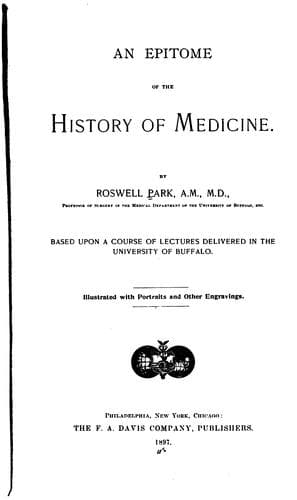
An Epitome of the History of MedicinePark, Roswell
History
An Epitome of the History of Medicine
Park, Roswell
Medicine -- History
The principal active constituent of coca-leaves was discovered about
1860 by Niemann, and called by him cocaine. It is an alkaloid which
combines with various acids in the formation of salts. It has the
quality of benumbing raw and mucous surfaces, for which purpose it was
applied first in 1862 by Schroff and in 1868 by Moreno. In 1880 Van
Aurap hinted that this property might some day be utilized. Karl Koller
logically concluded from what was known about it that this anaesthetic
property could be taken advantage of for work about the eye, and made
a series of experiments upon the lower animals, by which he established
its efficiency and made a brilliant discovery. He reported his
experiments to the Congress of German Oculists, at Heidelberg, in 1884.
News of this was transmitted with great rapidity, and within a few weeks
the substance was used all over the world. Its use spread rapidly to
other branches of surgery, and cocaine local anaesthesia became
quickly an accomplished fact. More time was required to point out its
disagreeable possibilities, its toxic properties, and the like, but it
now has an assured and most important place among anæsthetic agents, and
has been of the greatest use to probably ten per cent, of the civilized
world. To Koller is entirely due the credit of establishing its
remarkable properties.
The{315} writer makes no apology here for having introduced two distinct
chapters,--one upon the history of antiseptic surgery, the other upon
the history of anæsthesia. First of all, they are the two grandest
medical discoveries of all time; and, secondly, they are of Anglo-Saxon
origin,--the one British, the other American. To the introduction of
anaesthetics and antiseptics is due a complete revolution of earlier
methods, complete reversal of mortuary statistics, and the complete
relief of pain during surgical operations; in other words, to these two
discoveries the human race owes more of the prolongation of life and
relief of suffering than can ever be estimated or formulated in words.
What an everlasting disgrace it is that, while to the great murderers of
mankind, men like Napoleon in modern times and his counterparts in all
times, the world ever does honor, erects imposing monuments and writes
volumes of encomiums and flattering histories, the men to whom the world
is so vastly more indebted for all that pertains to life and comfort
are scarcely ever mentioned save in medical history, while the world
at large is even ignorant of their names. For this reason, if for
none other, these chapters find an appropriate place in a work of this
character.
Those interested in a somewhat more elaborate presentation of this
subject may find it in an anniversary address delivered by the writer on
October 16, 1896 (the semicentennial of Morton's public demonstration),
in the Medical School of the University of Buffalo, and published in the
_Buffalo Medical Journal_ of November, 1896.
CHAPTER XIII.
THE HISTORY OF ANTISEPSIS.
Public-domain text, read in full here on John Shaqi.
Reviews
Reviews
No reviews yet
Be the first to share your thoughts on this work.
Elsewhere in the archive
Join the Discussion
Join the discussion
Sign in to leave a comment or review.
Sign InorCreate an account