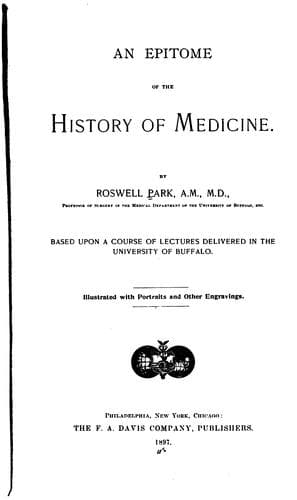
An Epitome of the History of MedicinePark, Roswell
History
An Epitome of the History of Medicine
Park, Roswell
Medicine -- History
The antiseptic method, as it has since been known, was naturally at
first crude, although its scientific basis has never been shaken; and
that it has been since, in large measure, modified, and that surgeons
now resort to little, if any, of the paraphernalia which first made it
such a formal proceeding, in no regard shake the scientific nature
of its foundation, but rather have tended ever to corroborate it and
establish it more and more firmly. Lister began with the supposition
that the air contains the germs which are most active and pernicious
in producing disease. It has been since learned that air-contact is,
perhaps, least of all to{324} be dreaded. We, however, recognize the
germs as always the efficient agents, though we have since learned that
other sources of contamination are much more to be dreaded than air.
It had been the custom, up to Lister's time, to observe usually the
ordinary forms of cleanliness, but, not appreciating the multitude of
germs which lurk in and about the skin, it had not been customary to
scour and prepare it as we have learned to do since Lister's day. The
ligatures and instruments which were used and the dressings which were
applied, as well as the sponges used during the operation, usually went
through the ordinary forms of cleansing; and yet Lister's investigations
showed the utter inadequacy of such preparation. His most important
object-lesson, however, was that everything that came in contact with
fresh or bleeding tissues might carry infectious material (i.e.,
germs), unless it had itself been thoroughly freed from their
presence. Accordingly, the system taught the accurate preparation of
everything.--from the skin of the patient, which was to be carefully
cleansed and shaven, to the hands of the operator, which were to be
scrupulously scrubbed, as well as those of every assistant who might
handle or touch any of the instruments or dressing materials. It
included, also, the careful preparation of sponges, sutures, and
ligature materials, all of which were kept protected from air-contact
and in antiseptic solutions until the moment of their use. The dressing
materials were impregnated with substances like carbolic acid, which had
been proven to be germicidal; and impermeable material, like oiled silk,
was used to cover the surgical dressing, in order that fluids which
might leak through should not come in contact with the air, which might
permit of their putrefaction, while, at the same time, air from without
could have no access to the deeper parts thus protected.
Public-domain text, read in full here on John Shaqi.
Reviews
Reviews
No reviews yet
Be the first to share your thoughts on this work.
Elsewhere in the archive
Join the Discussion
Join the discussion
Sign in to leave a comment or review.
Sign InorCreate an account