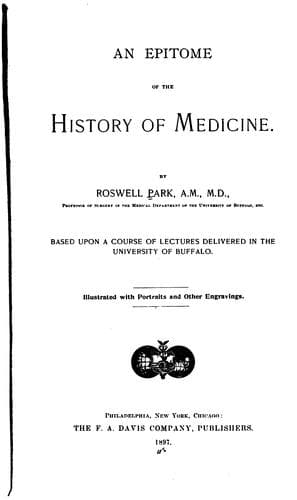
An Epitome of the History of MedicinePark, Roswell
History
An Epitome of the History of Medicine
Park, Roswell
Medicine -- History
his experiments; this was money most happily employed, since it made
possible a number of important discoveries. It is said that Bacon
knew the properties of convex and concave lenses, and was the first to
conceive of the microscope and telescope; his astronomical knowledge led
him to demand a reform in the calendar, which Gregory XIII carried out
three centuries later; he had knowledge of gunpowder and its effects,
and was, in fact, the wizard of his day; but his boldness and
originality drew upon him the enmity of the church, by which he was
persecuted and finally condemned to imprisonment for life upon a diet of
bread and water, although he was ultimately released, in 1266, by Pope
Clement IV. He wrote extensively, but only fragments of his works
exist, since the friars believed{069} them tainted with witchcraft and
prevented their publication.
Before and during the time of Roger Bacon the philosophers were divided
into two parties, which engaged in very unseemly and unphilosophic
strife. One was termed the _Realist_, and believed, with Plato, that
ideas are self-existent and independent of the mind,--in other words,
veritable entities; the other, the _Nominalist_, held, with Aristotle,
that general ideas are pure abstractions formed by the mind with the
aid of sensations received from without, without which they could never
exist,--that is, if a being could be imagined without sensibilities and
the power of sensation, such being would be destitute of ideas. These
two parties kept up a very active warfare, and enlisted the aid of both
civil and ecclesiastical authorities, the result being persecution of
each other, and that general unsatisfactory conflict into which theology
and metaphysical speculation always force those who indulge in them.
Now, regarding the condition of medical affairs in the Empire of the
West: Down to the seventh century, in Rome, there were court-archiaters
who were attached to the retinues of the nobles, and in each large city
popular archiaters formed a college charged with sanitary matters, the
instruction and examination of candidates, and gratuitous services to
the poor. Although there is little definite information available, it
is probable that after the ruin of Alexandria much the same medical
organization obtained in those provinces as continued under the Greek
Empire at Constantinople. Under Arab sway we know very little of what
rules or regulations governed instruction in medicine and its practice;
and, so soon as one of these countries fell under the rule of the
Turks, all scientific institutions seem to have decayed or been
discontinued,--or, as Renouard states it: "If we may judge by what still
exists to-day in this unfortunate country (Turkey), consumed by the
power of ignorance{070} and despotism, the most complete anarchy
followed all older organizations."
Public-domain text, read in full here on John Shaqi.
Reviews
Reviews
No reviews yet
Be the first to share your thoughts on this work.
Elsewhere in the archive
Join the Discussion
Join the discussion
Sign in to leave a comment or review.
Sign InorCreate an account