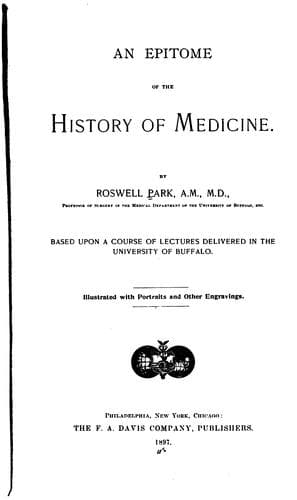
An Epitome of the History of MedicinePark, Roswell
History
An Epitome of the History of Medicine
Park, Roswell
Medicine -- History
During the Middle Ages, in the Empire of the West, arose the School of
Salernum, which became so celebrated that, like that of Alexandria, it
deserves special mention. The modern city of Salerno is situated on the
Neapolitan Gulf, about thirty miles southeast of the city of Naples,
with a population of but a few thousand souls. The ancient city stood
upon a height in the rear of the present town, where the ruins of its
mediaeval citadel are still to be seen. It first appeared in history
194 B.C., when a Roman colony was founded, was a municipal town of
importance, and appears even at this early day to have been a health
resort, since Horace informs us he had been advised to substitute
its cool baths for the warm ones of Baiæ. During the stormy centuries
following the downfall of the Western Empire, Salerno successively
submitted to the sway of the Goths, Lombards, Franks, Saracens, and
Greeks, as the vicissitudes of Avar compelled. Under the Lombards it
became the residence of the Duke of Benevcntum, and, in 1075, when
taken by Robert Guiscard of Normandy, it fell to the crown of Naples,
in consequence of which in the fourteenth century, the heir apparent of
this kingdom took the title of Prince of Salernum.
During the Middle Ages here flourished a medical school, important not
alone because of its celebrity at the time, but{073} for its effect upon
the medical history of the future. Its origin is obscure, though it has
been ascribed to Charlemagne in 802; again, its founding has been held
to be the work of fugitives from Alexandria when that city was captured
by the Saracens, 640 A.D.; some attribute it to the Benedictine order of
monks, others to Saracens, etc. The foundation by Alexandrian fugitives
is probably conjectural, yet it must be admitted there is some evidence
of knowledge of Arabian medicine in Salernum as early as this. Be the
origin what it may, it is certain that the Benedictine monks exercised
a very important influence upon this school, and there is considerable
reason to think that it was really originated by them. Their monastery
of Monte Casino was located about fifty miles the other side of Naples,
occupying the site of an ancient temple of Apollo; the rules of the
order enjoined the care of the sick and treatment by prayer, and St.
Benedict himself was credited with performing miraculous cures. The
rules which forbade public instruction were gradually discarded, for
in the ninth century Abbot Bertharius wrote two books on the art of
healing, and by the tenth century Monte Casino had acquired great
reputation as a medical school, and was sought by medically-inclined
monks from all quarters. A little later (1022) King Henry II, of
Bavaria, Emperor of Germany, is said to have been cut for stone by St.
Benedict himself, who appeared in ghostly form and operated with such
skill that on awaking the royal patient found the calculus in his hand,
and only the cicatrix of the wound through which it had been removed.
Public-domain text, read in full here on John Shaqi.
Reviews
Reviews
No reviews yet
Be the first to share your thoughts on this work.
Elsewhere in the archive
Join the Discussion
Join the discussion
Sign in to leave a comment or review.
Sign InorCreate an account