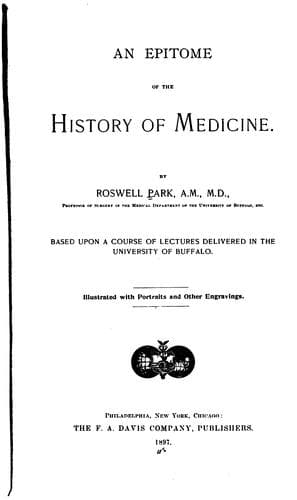
An Epitome of the History of MedicinePark, Roswell
History
An Epitome of the History of Medicine
Park, Roswell
Medicine -- History
Another of the distinguished Salernian physicians of the thirteenth
century, one highly esteemed by Frederick II, was John of Procida, who
also was active in producing--if not the real author of--the massacre of
the Sicilian Vespers, A.D. 1282. In a dispute concerning the question of
the two Sicilies he embraced the cause of Prince Manfred, for which he
was banished by Charles of Anjou, and took refuge at the court of Peter
III, of Arragon, by whom he was created a baron; and he was influential
in persuading the latter to assert his claim to the throne of Sicily.
By various intrigues at different courts he succeeded in organizing an
alliance, which betrayed its existence in this massacre, and finally
resulted in the overthrow of the French in Sicily and the transfer
of the island to the crown of Spain. He was author of at least two
treatises devoted to medicine and philosophy.
Other writers of the School of Salernum were: a learned Jew of
Agrigentum known as "Farragus," Matthew Sylvaticus, Graphæus, and
Cappola. About the middle of the fifteenth century flourished Saladino,
famous as an authority on materia medica.
It is of no small interest that now, for the first time in history,
women began to figure somewhat prominently as writers, practitioners,
and even teachers of medicine. About the middle of the eleventh century
appeared a work, entitled _De Midierium Passionibus_, attributed to the
before-mentioned Trotula, wife of John Platearius, which has descended
even to these days. There is nothing in the work to indicate the name
or sex of the author, who is invariably spoken of in the third person;
consequently Trotula's connection therewith has often been disputed.
It mentions{080} a certain "_aqua mirabilis_" composed largely of
brandy, which spirit is said to have first been employed medicinally by
Thaddeus of Florence, who died in 1295; there is also an account of a
patient who _wore spectacles!_ The diseases of women and children are
also largely dealt with. The work is undoubtedly an anonymous production
of the eleventh century, disfigured by additions of a later day, and
ascribed to Trotula, perhaps, because of the celebrity that attached
to her; at all events, it is the earliest work ascribed to a female
physician, and thus possesses special claims to interest.
Later we read of Sichelguada, wife of Robert Guiscard and a graduate of
Salernum, who endeavored to poison her step-son, Bohemond, in order to
secure the succession of her own child. This infamous plot was furthered
by some of the Salernian physicians, and thwarted only by the prompt
action of Guiscard, who swore he would slay his wife with his own sword
should the malady of Bohemond prove fatal.
Public-domain text, read in full here on John Shaqi.
Reviews
Reviews
No reviews yet
Be the first to share your thoughts on this work.
Elsewhere in the archive
Join the Discussion
Join the discussion
Sign in to leave a comment or review.
Sign InorCreate an account