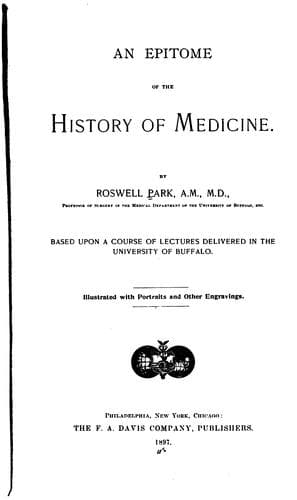
An Epitome of the History of MedicinePark, Roswell
History
An Epitome of the History of Medicine
Park, Roswell
Medicine -- History
Such was the school of Salernum in its prime, during the twelfth and
thirteenth centuries. My readers will not have failed to note how few
names have been mentioned which are prominent in medical history, and
how few improvements were made in medical art by those who have been
mentioned. One naturally inquires, then, what was the source of the
wide-spread fame of Salerno as a school, since it was distinguished
neither by notable discovery in science nor by celebrated teachers, and
the predominant element was doubtless one of obstinate conservatism and
unswerving devotion to ancient doctrines. Founded during the dark period
of the Middle Ages, at a time when ignorance, bigotry, and superstition
prevailed, it preserved, amidst the gloom that had settled upon Europe,
a few rays of that intellectual light which had shown so brightly in the
golden ages of Roman history. These rays, made more conspicuous by the
intellectual night which they barely illumined, were a beacon for
men who were groping for more light. Thus the name of Salernum became
synonymous with intellectual advancement in later ages. As the parent
and model of our modern university system, Salernum yet deserves, in a
measure, to enjoy the esteem of a numerous scholastic offspring. At a
time when priests were particularly active in passing off rudimentary
knowledge for the science of healing this school began to secure all
information possible from the laity for the progressive development of
medicine. It began, in other words, to hold aloof and then to break away
from the fetters of a fanatical church. Its decline, too, was as rapid
as its career had been brilliant. One very serious blow was struck
when, in 1224, Frederick II founded the University of Naples and forbade
Neapolitan subjects to seek instruction at any other university. The
next year a revolt in the city provoked the closure of the schools{085}
of Bologna, which were, however, opened again two years later. Within
a short time the universities of Naples, Montpellier, Padua, Paris, and
Bologna all entered into a contest for pre-eminence with a rivalry which
was not always generous. In 1224, it is said, the latter university had
no less than ten thousand students. Happily, however, the period of
the Renaissance proved to be one of emancipation from the fetters of
ignorance and superstition, making an appeal for liberty which the
conservatism of Salernum could not brook. Roger Bacon, in England;
Lanfranc and Guy de Chauliac, in France; Mondino, at Bologna, and
Savonarola, at Padua, found no rivals at Salernum to successfully
contest their fame. Thus this ancient school fell behind the age, and in
a short time sank into a mediocrity which was scarcely brightened by the
reflection of a departed glory. In 1342 Robert I renewed the decree of
Frederick II, which closed all the schools in his kingdom save those of
Naples, but excepted Salernum solely because of its antiquity and the
traditions of his predecessors.
Public-domain text, read in full here on John Shaqi.
Reviews
Reviews
No reviews yet
Be the first to share your thoughts on this work.
Elsewhere in the archive
Join the Discussion
Join the discussion
Sign in to leave a comment or review.
Sign InorCreate an account