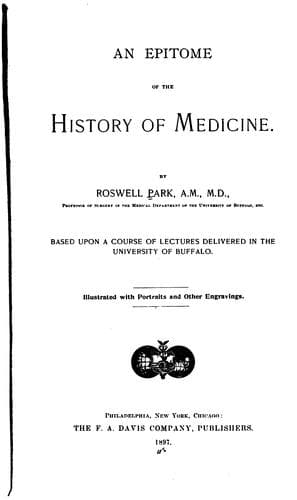
An Epitome of the History of MedicinePark, Roswell
History
An Epitome of the History of Medicine
Park, Roswell
Medicine -- History
"Never since Hippocrates," says Malgaigne, "has medicine learned a
language stamped with such nobility and in such few words." Although
a follower of Galen, in anatomy he insisted on the necessity of
dissection, and proposed to make use of the corpses of executed
criminals for this purpose. The drawings made by Henri de Mondeville
were known to him; he divided abscesses into hot and cold, although
among the latter he included oedcma, tympanites, dropsy, scirrhus, and
other conditions. In practice he was more timid, yet more active,{095}
than Lan franchi, who never cut for stone, but left that operation
to the traveling surgeons. De Ghauliac described it as he had seen it
performed; he opened the abdomen for dropsy, did not hesitate to attempt
the radical cure of hernia, and operated for cataract. The plague which
raged during the fourteenth century and depopulated the known world of
one-fourth of its inhabitants, twice appeared in Avignon while Guy de
Chauliac was a resident there--and he acknowledges that nothing but
shame prevented him from fleeing. He remained at his post, visited the
sick, and was himself attacked and left for dead. "In this frightful
position he had sufficient presence of mind to follow the peculiarities
of his case, analyze his own sufferings, and to give a description
of them worthy of Hippocrates" (Renouard). His work soon became the
surgical code of Christendom, and was commented upon and translated into
all tongues, remaining for a long time a classic, and even at this
day it preserves much of its interest as representing the condition of
medical science at the close of the Middle Ages; moreover, its literary
style was much superior to that of any of his contemporaries, all of
whom wrote very barbarous Latin. He died about 1370.
With the death of de Chauliac terminates our interest, not merely in the
Arabian physicians and those who were intimately connected with them,
but in the so-called Arabic Period. It may be added, in passing, that
the followers of Mahomet, like those of Christ, erected by the side of
each of their mosques a school, and often a hospital, endowed with more
or less generosity by caliphs or the wealthy, who hoped to purchase
redemption and eternal happiness by such liberality.
Public-domain text, read in full here on John Shaqi.
Reviews
Reviews
No reviews yet
Be the first to share your thoughts on this work.
Elsewhere in the archive
Join the Discussion
Join the discussion
Sign in to leave a comment or review.
Sign InorCreate an account